 Indietro
General Biology: Chapter 1 & 13 Key Concepts
 01:35

Termini in questo insieme (20)
Biology is the scientific study of life.
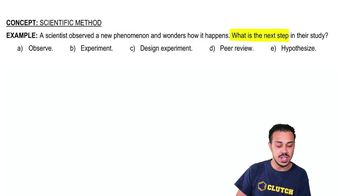
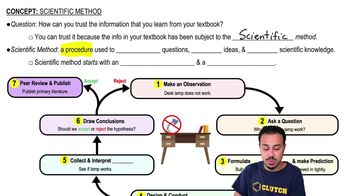
Exploration → Hypothesis → Prediction → Experiment → Communication and Outcomes.
A hypothesis must be testable and falsifiable.
Peer review involves qualified, impartial experts evaluating research to ensure quality and validity before publication.
A theory is a comprehensive, well-substantiated explanation supported by a large body of evidence, broader than a hypothesis.
A fact is information considered objectively true based on current evidence and verifiable observations.
An experiment comparing groups that differ in only one variable, with a control group lacking the tested factor and an experimental group receiving it.
Order, Cells, Growth and Development, Energy Processing, Regulation, Reproduction, Response to Environment, and Evolution.
Biological structures are shaped to perform specific functions, seen at molecular to organ levels.
Lungs have a branched structure providing large surface area for air exchange; red blood cells have indentations increasing oxygen diffusion.
Information must be received, transmitted, and used for life functions, such as gene expression and hormonal regulation.
Adenine (A), Guanine (G), Cytosine (C), and Thymine (T).
Energy flows through ecosystems entering as light and exiting as heat; matter is recycled within the system.
Metabolism is the network of chemical reactions in cells that convert energy and recycle matter.
New properties that arise from the specific arrangement and interactions of parts at higher levels of complexity.
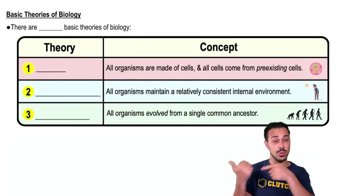
Evolution is the process of change transforming life on Earth, explaining unity and diversity of organisms.
Natural selection is the process where individuals with traits best suited to their environment survive and reproduce more successfully.
Mutations occur randomly and provide genetic variation; natural selection edits these changes by favoring beneficial traits.
Comparing DNA sequences among species reveals common ancestors and evolutionary trees.
Science requires repeatability, peer review, openness to criticism, and builds on multiple lines of evidence.