 Indietro
General Biology: Chapter 5 Review - Macromolecules and Their Structures
 01:17
01:17
Termini in questo insieme (26)
A dehydration reaction is a chemical process that removes a water molecule to form a new bond, enabling the production of polymers from monomers.
Hydrolysis is the chemical breakdown of polymers by adding water, which breaks the bonds between monomers.
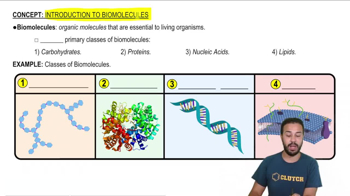
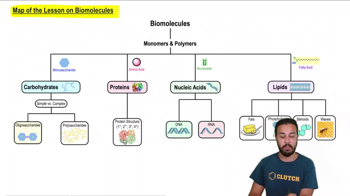
Carbohydrates are organic molecules that serve as energy sources and structural components in cells.
Carbohydrates provide energy storage, serve as structural components (like cellulose), and are involved in cell recognition.
Monosaccharides are single sugars, disaccharides are two monosaccharides linked, and polysaccharides are long chains of monosaccharides.
The bond between monosaccharides is called a glycosidic linkage.
Lipids are hydrophobic molecules used for energy storage, membrane structure, and signaling.
Lipids function in long-term energy storage, forming cell membranes, and acting as hormones.
Examples include triacylglycerols (fats/oils), phospholipids, and steroids.
Fats are made of glycerol and three fatty acids.
A triglyceride consists of glycerol linked to three fatty acids by ester linkages.
Saturated fatty acids have no double bonds and are solid at room temperature; unsaturated fatty acids have one or more double bonds and are liquid.
Proteins are polymers of amino acids that perform diverse functions including catalysis, structure, and signaling.
Proteins function as enzymes, structural components, transporters, and signaling molecules.
Proteins are made of amino acids linked by peptide bonds.
An amino acid has an amino group, a carboxyl group, a hydrogen atom, and an R group attached to a central carbon.
Nonpolar amino acids are hydrophobic; polar and electrically charged amino acids are hydrophilic.
The bond linking amino acids is called a peptide bond.
A polypeptide is a chain of amino acids; a protein is a functional molecule made of one or more polypeptides folded into a specific shape.
Protein structure levels are primary (amino acid sequence), secondary (alpha helices and beta sheets), tertiary (3D folding), and quaternary (multiple polypeptides).
Nucleic acids are polymers that store and transmit genetic information.
The two kinds are DNA and RNA.
Nucleic acids are made of nucleotides.
A nucleotide consists of a nitrogenous base, a pentose sugar, and one or more phosphate groups.
Nucleotides are linked by phosphodiester linkages.
DNA stores genetic information; RNA helps in protein synthesis and gene regulation.