Cytology is the study of cell structures using microscopes.
What limits the resolution of a light microscope?
Resolution is limited by the shortest wavelength of light, about 2 microns, which restricts clarity to about 1,000x magnification.
How do electron microscopes differ from light microscopes?
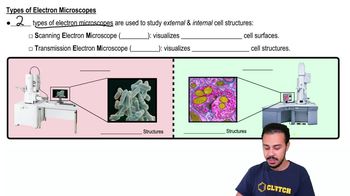
Electron microscopes use electromagnets to focus electron beams, achieving higher resolution (~2 nm) but only on dead cells.
What is the purpose of cell fractionation?
Cell fractionation separates organelles to study their individual functions by spinning cell components at increasing speeds.
What distinguishes prokaryotic from eukaryotic cells?
Prokaryotes lack nuclei and membrane-bound organelles; eukaryotes have nuclei and internal membranes compartmentalizing functions.
Name three organelles typically found in plant cells but not in animal cells.
Plant cells usually have a cell wall, chloroplasts, and a large central vacuole, which animal cells generally lack.
What is chromatin?
Chromatin is DNA organized with proteins into thin fibers that coil into chromosomes during cell division.
What is the function of ribosomes?
Ribosomes synthesize proteins; they can be free in the cytosol or bound to the ER and nuclear envelope.
What are the main functions of rough and smooth endoplasmic reticulum (ER)?
Rough ER has ribosomes and produces membrane and secretory proteins; smooth ER synthesizes steroids, metabolizes carbs, stores calcium, and detoxifies poisons.
What role does the Golgi apparatus play in the cell?
The Golgi modifies, sorts, and ships proteins and synthesizes some polysaccharides; it receives vesicles at the cis face and ships from the trans face.
What are lysosomes and their function?
Lysosomes are membranous sacs with hydrolytic enzymes that digest macromolecules and recycle cellular materials.
Describe the structure and function of mitochondria.
Mitochondria have an outer membrane and folded inner membrane (cristae); they perform cellular respiration to produce ATP.
What is the function of chloroplasts?
Chloroplasts contain chlorophyll and pigments for photosynthesis; they have two membranes and internal thylakoids stacked into grana.
What are peroxisomes and their metabolic role?
Peroxisomes generate and degrade hydrogen peroxide (H2O2), detoxify substances like alcohol, and convert fatty acids to sugars in glyoxysomes.
What are the three main components of the cytoskeleton?
The cytoskeleton is made of microtubules, microfilaments, and intermediate filaments, providing support, motility, and regulation.
What is the role of microtubules?
Microtubules shape cells, guide organelle movement, separate chromosomes during division, and form cilia and flagella.
What functions do microfilaments serve?
Microfilaments, made of actin, support cell shape, enable muscle contraction, amoeboid movement, and cytoplasmic streaming.
What are intermediate filaments?
Intermediate filaments are fibrous proteins like keratin that support cell shape and anchor organelles.
What composes the plant cell wall?
Plant cell walls are made of cellulose fibers embedded in polysaccharides and proteins.
What is the extracellular matrix (ECM) in animal cells?
The ECM is a network of secreted glycoproteins like collagen that supports, adheres, and regulates animal cells.
Name the three types of animal cell junctions and their functions.
Tight junctions bind cells to prevent fluid leakage, desmosomes anchor cells and cytoskeletons, and gap junctions allow communication via small molecule passage.
What are plasmodesmata?
Plasmodesmata are channels through plant cell walls that allow cytoplasmic exchange between adjacent cells.
 Indietro
 06:35