 Indietro
General Biology Chapter 6: Metabolism and Enzymes
 02:17

Termini in questo insieme (36)
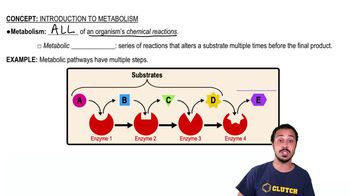
Metabolism is the sum of all chemical reactions that occur within a living organism to maintain life.
The First Law of Thermodynamics states that energy cannot be created or destroyed, only transformed or transferred.
The Second Law of Thermodynamics states that every energy transfer increases the entropy (disorder) of the universe.
Entropy is a measure of disorder or randomness in a system.
Bioenergetics is the study of how energy flows through living organisms.
A metabolic pathway is a series of linked chemical reactions within a cell.
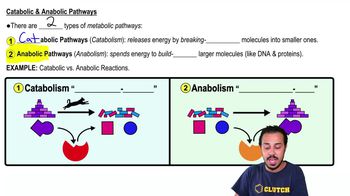
Anabolic processes build complex molecules from simpler ones, requiring energy input.
Catabolic processes break down complex molecules into simpler ones, releasing energy.
Common forms of energy include kinetic, potential, chemical, thermal, and light energy.
Conduction is heat transfer through direct contact between molecules.
Convection is heat transfer by the movement of fluids (liquids or gases).
Radiation is heat transfer through electromagnetic waves without needing a medium.
Evaporation is the process where liquid changes to gas, removing heat and cooling the surface.
Membrane potential is the voltage difference across a cell membrane due to ion distribution.
Energy cycling refers to the continuous flow and transformation of energy within biological systems.
Gibbs Free Energy is the energy available to do work, represented as \(\Delta G\).
A spontaneous process occurs without energy input and usually decreases free energy (\(\Delta G < 0\)).
Equilibrium is the state where forward and reverse reactions occur at the same rate, and \(\Delta G = 0\).
A closed system exchanges energy but not matter; an open system exchanges both energy and matter with its surroundings.
ATP (adenosine triphosphate) is the primary energy currency of the cell.
Enzymes are biological catalysts that speed up chemical reactions without being consumed.
Activation energy is the energy required to start a chemical reaction.
The transition state is a high-energy, unstable state during a chemical reaction.
\(\Delta G\) represents the change in Gibbs free energy during a reaction.
The active site is the region on an enzyme where substrate molecules bind and undergo a reaction.
Catalytic activity refers to an enzyme's ability to increase the rate of a chemical reaction.
Induced fit is the change in enzyme shape that enhances substrate binding during catalysis.
Turnover number (Kcat) is the number of substrate molecules converted to product per enzyme per second.
Vmax is the maximum rate of an enzyme-catalyzed reaction when the enzyme is saturated with substrate.
Km is the substrate concentration at which the reaction rate is half of Vmax.
A cofactor is a non-protein chemical that assists enzyme function.
Coenzymes are organic cofactors that help enzymes catalyze reactions.
Competitive inhibition occurs when an inhibitor binds the active site, blocking substrate binding.
Non-competitive inhibition occurs when an inhibitor binds elsewhere on the enzyme, changing its shape and function.
Allosteric regulation involves molecules binding to sites other than the active site to activate or inhibit enzyme activity.
Feedback inhibition is when the end product of a metabolic pathway inhibits an earlier enzyme to regulate the pathway.