 Indietro
General Biology: Chapters 4 & 5 Key Concepts
 01:17

Termini in questo insieme (20)
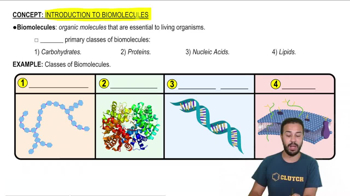
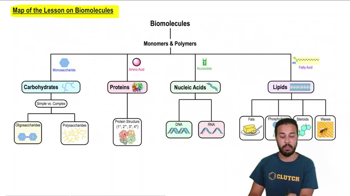
Carbohydrates provide energy and structural support in cells.
Monosaccharides are simple sugars and the basic units of carbohydrates.
Starch is a storage polysaccharide in plants; cellulose provides structural support in plant cell walls.
A phospholipid has two fatty acid tails and a phosphate group head, forming cell membranes.
Proteins function as enzymes, structural components, signaling molecules, and transporters.
The primary structure is the linear sequence of amino acids in a polypeptide chain.
Saturated fatty acids have no double bonds; unsaturated fatty acids have one or more double bonds causing kinks.
Nucleic acids store and transmit genetic information.
DNA contains adenine, thymine, cytosine, and guanine.
Peptide bonds link amino acids in proteins.
The fluid mosaic model describes the membrane as a fluid bilayer of phospholipids with embedded proteins.
Cholesterol stabilizes membrane fluidity across temperature changes.
Dehydration synthesis is the process of joining molecules by removing water.
Hydrolysis breaks bonds by adding water, splitting polymers into monomers.
Enzymes lower activation energy and speed up reactions without being consumed.
A protein's 3D shape is determined by its amino acid sequence and interactions like hydrogen bonds and disulfide bridges.
DNA is double-stranded with deoxyribose sugar; RNA is single-stranded with ribose sugar.
The four levels are primary, secondary, tertiary, and quaternary structures.
Cellulose provides rigidity and structural support in plant cell walls.
Phospholipids have hydrophilic heads and hydrophobic tails, enabling membrane formation.