 Indietro
General Biology: Chemical Basis of Life
 02:13

Termini in questo insieme (24)
Matter is anything that occupies space and has mass, existing in solid, liquid, or gas states.
An element is a substance that cannot be broken down into other substances by ordinary chemical means.
A compound is a substance consisting of two or more different elements combined in a fixed ratio, with properties different from its elements.
Oxygen, carbon, hydrogen, nitrogen, calcium, and phosphorus make up about 99% of the human body.
Trace elements are elements required in minute quantities (less than 0.01% of body weight) essential for health, such as iron and iodine.
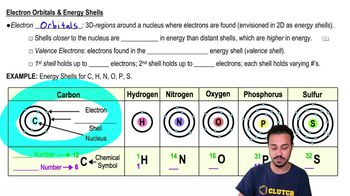
An atom is the smallest unit of matter that retains the properties of an element, composed of protons, neutrons, and electrons.
The atomic number is the number of protons in an atom's nucleus and is unique to each element.
Isotopes are atoms of the same element with the same number of protons but different numbers of neutrons.
Radioactive isotopes serve as tracers to follow molecules in organisms and are used in medical diagnosis and treatment.
The number of electrons in the outermost shell, called the valence shell, determines an atom's chemical properties.
A covalent bond forms when two atoms share one or more pairs of electrons to complete their outer shells.
Nonpolar covalent bonds share electrons equally; polar covalent bonds share electrons unequally due to differences in electronegativity.
An ionic bond is an attraction between oppositely charged ions formed by the transfer of electrons from one atom to another.
Sodium donates an electron to chlorine, forming positively charged Na+ and negatively charged Cl- ions that attract each other.
A hydrogen bond is a weak attraction between a partially positive hydrogen atom and a partially negative atom (often oxygen or nitrogen) in another molecule.
Water molecules are polar because oxygen is more electronegative, pulling shared electrons closer and creating partial charges.
Cohesion is the tendency of water molecules to stick to each other via hydrogen bonds, important for processes like water transport in plants.
Water absorbs or releases large amounts of heat when hydrogen bonds break or form, stabilizing temperature changes.
Ice is less dense than liquid water because stable hydrogen bonds hold molecules in a spacious crystal lattice.
Water's polarity allows it to surround and dissolve ionic and polar substances, making it the solvent of life.
pH measures the concentration of hydrogen ions (H+) in a solution, indicating its acidity or basicity on a scale from 0 to 14.
A buffer is a substance that minimizes pH changes by accepting or donating hydrogen ions.
Increased CO2 lowers ocean pH, reducing carbonate ions needed for coral calcification, slowing coral growth and harming reef ecosystems.
Water's unique properties support life on Earth, so its presence on other planets suggests potential for life.