 Indietro
General Biology: Chemical Bonds, Water Properties, Carbon, and Functional Groups
 1:59
1:59
Termini in questo insieme (20)
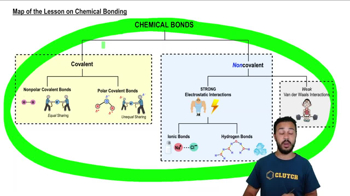
A covalent bond is the sharing of a pair of valence electrons by two atoms.
Electronegativity is an atom's attraction for electrons in a covalent bond. More electronegative atoms pull shared electrons more strongly, causing polar covalent bonds.
Nonpolar covalent bonds share electrons equally, while polar covalent bonds share electrons unequally due to differences in electronegativity.
An ionic bond forms when atoms transfer electrons, creating oppositely charged ions (cations and anions) that attract each other.
Hydrogen bonds form when a hydrogen atom covalently bonded to one electronegative atom is attracted to another electronegative atom, important in water's properties.
Cohesive behavior, temperature moderation, expansion upon freezing, and versatility as a solvent.
Ice is less dense than liquid water because hydrogen bonds hold molecules apart in a lattice, insulating aquatic life below.
Weak attractions between molecules caused by fleeting uneven electron distributions, important in biological structures like gecko toe hairs.
Carbon has four valence electrons allowing it to form four covalent bonds with many elements, creating complex molecules.
Organic molecules consisting only of carbon and hydrogen, often found in fats and capable of releasing large amounts of energy.
Isomers have the same molecular formula but different structures: structural, cis-trans (geometric), and enantiomers (mirror images).
Enantiomers can have different biological effects; often only one is biologically active, important in pharmaceuticals.
A functional group is a specific group of atoms that confers distinct chemical properties to organic molecules.
Hydroxyl, carbonyl, carboxyl, amino, sulfhydryl, phosphate, and methyl groups.
Polar, forms hydrogen bonds with water, important in dehydration synthesis, found in carbohydrates and alcohols.
Acidic group that can donate H+, found in carboxylic acids and organic acids.
Basic group that can accept H+, found in amines and amino acids.
Forms disulfide linkages in proteins, important for protein structure.
Stores energy in molecules like ATP, important in organic phosphates.
Adenosine triphosphate (ATP) stores potential energy in phosphate bonds, releasing energy when reacting with water for cellular processes.