 Indietro
General Biology: Chemical Context of Life
 01:54
01:54
Termini in questo insieme (25)
Matter is anything with mass and occupies space (e.g., water, air). An atom is the smallest unit of an element (e.g., hydrogen atom). A compound is a substance made of two or more elements in a fixed ratio (e.g., water H2O, carbon dioxide CO2).
The major elements are carbon (C), hydrogen (H), oxygen (O), and nitrogen (N). Other essential elements include phosphorus (P), sulfur (S), calcium (Ca), and potassium (K). Trace elements like iron (Fe) and iodine (I) are needed in small amounts.
An atom is the smallest unit of an element, which is a substance made of one kind of atom. Protons (positive) and neutrons (neutral) are in the nucleus; electrons (negative) orbit the nucleus.
Atomic number is the number of protons in the nucleus and defines the element. A neutral atom has equal numbers of protons and electrons.
Atomic mass is the sum of protons and neutrons in the nucleus. For example, an atom with 6 protons and 6 neutrons has an atomic mass of 12.
Isotopes are atoms of the same element with different neutron numbers (e.g., carbon-12, carbon-14). Radioisotopes have unstable nuclei that emit radiation, used in medical imaging and fossil dating.
Energy is the capacity to do work. Potential energy is stored energy due to position. Kinetic energy is energy of motion.
Electrons are found in the electron cloud occupying energy levels. The octet rule states atoms are most stable with eight electrons in their outer shell.
Electron arrangement in shells determines reactivity. Atoms with incomplete outer shells are reactive; full shells (noble gases) are stable and less reactive.
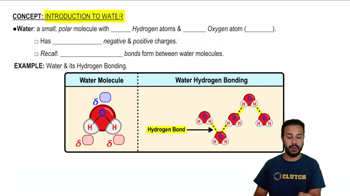
A chemical bond is an attraction between atoms. Covalent bonds share electrons (e.g., water), while ionic bonds transfer electrons (e.g., salt).
Covalent bonds share electrons: single (1 pair), double (2 pairs), triple (3 pairs). Valence is electrons available for bonding. Electronegativity affects bond polarity: polar bonds share unequally (e.g., H2O), nonpolar share equally (e.g., O2).
Ionic bonds form between oppositely charged ions: cations (positive) and anions (negative). An aqueous solution has water as solvent. Salt is an ionic compound (e.g., NaCl).
Hydrogen bonds are weak attractions between hydrogen and electronegative atoms like oxygen or nitrogen. They stabilize water and DNA structures.
A chemical reaction changes substances. Reactants are starting materials; products are formed substances. Chemical equilibrium occurs when forward and reverse reactions balance.
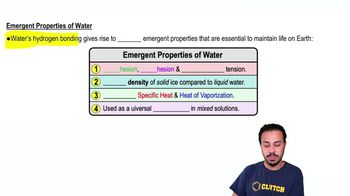
Water's polarity enables hydrogen bonds, causing cohesion (water sticks to itself), adhesion (water sticks to other surfaces), and high surface tension.
Temperature measures average kinetic energy. Thermal energy is total kinetic energy of particles. Heat is energy transfer between objects.
A calorie raises 1g of water by 1°C; a kilocalorie is 1000 calories. Specific heat is heat to raise 1g of substance by 1°C. Heat of vaporization converts liquid to gas; heat of fusion converts solid to liquid.
Water's high specific heat and heat of vaporization absorb and release heat slowly, stabilizing temperatures and supporting life.
A solvent dissolves a solute to form a solution. For example, water (solvent) dissolves salt (solute) to make salt water.
Water's polarity allows it to dissolve ionic and polar molecules by surrounding them, but it cannot dissolve nonpolar molecules like oil.
Hydrophilic substances dissolve in water due to polarity; hydrophobic substances do not dissolve because they are nonpolar.
A mole represents \(6.022 \times 10^{23}\) particles, used to measure amounts of substances in chemistry.
\(H^+\) is a hydrogen ion (proton), \(OH^-\) is hydroxide ion. The pH scale measures acidity: acids increase \(H^+\), bases decrease it, and neutral solutions have equal \(H^+\) and \(OH^-\).
Buffers minimize pH changes by absorbing excess \(H^+\) or \(OH^-\). Blood contains buffers to keep pH stable, vital for life.
Ocean acidification is the decrease in ocean pH due to increased CO2, harming marine organisms by dissolving shells and affecting coral reefs, threatening biodiversity.