 Indietro
General Biology: Chemical Context of Life
 02:13
02:13
Termini in questo insieme (21)
An element is a substance that cannot be broken down to other substances by chemical reactions.
A compound is a substance consisting of two or more elements in a fixed ratio.
About 20–25% of the 92 natural elements are essential elements required for life.
Trace elements are required by an organism in only minute quantities.
Atoms consist of protons (positive charge), neutrons (no charge), and electrons (negative charge).
Isotopes are atoms of the same element that differ in the number of neutrons.
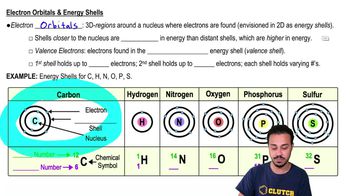
The atomic number is the number of protons in an atom's nucleus.
Valence electrons are electrons in the outermost shell that determine an atom's chemical behavior.
A covalent bond is the sharing of a pair of valence electrons by two atoms.
A single bond shares one pair of electrons; a double bond shares two pairs.
Electronegativity is an atom's attraction for electrons in a covalent bond.
Nonpolar covalent bonds share electrons equally; polar covalent bonds share electrons unequally due to differing electronegativities.
An ionic bond forms when one atom strips electrons from another, creating charged ions.
A cation is a positively charged ion; an anion is a negatively charged ion.
Salts are ionic compounds formed by ionic bonds, often found as crystals like sodium chloride.
A hydrogen bond forms when a hydrogen atom covalently bonded to one electronegative atom is attracted to another electronegative atom.
Van der Waals interactions are weak attractions between molecules due to uneven electron distribution.
Molecular shape determines how biological molecules recognize and respond to one another.
Chemical reactions involve the making and breaking of chemical bonds to convert reactants into products.
Chemical equilibrium is reached when forward and reverse reactions occur at the same rate, stabilizing reactant and product concentrations.
Photosynthesis: Sunlight powers conversion of carbon dioxide and water into glucose and oxygen: \(6\ CO_2 + 6\ H_2O \rightarrow C_6H_{12}O_6 + 6\ O_2\)