 Indietro
General Biology: Chemical Context of Life
 02:13
02:13
Termini in questo insieme (28)
Matter is anything that takes up space and has mass. It is composed of elements, which are substances that cannot be broken down by chemical reactions.
About 25 of the 92 natural elements are essential to life. Carbon, hydrogen, oxygen, and nitrogen make up 96% of living matter.
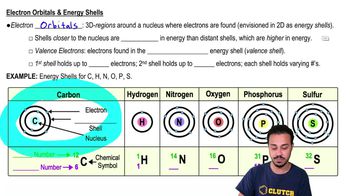
An atom consists of a nucleus containing protons and neutrons, surrounded by a cloud of electrons.
Atomic number is the number of protons in the nucleus. Mass number is the sum of protons and neutrons.
Isotopes are atoms of the same element with different numbers of neutrons. Some isotopes are radioactive and used as biological tracers.
Potential energy is the energy matter has due to its location or structure. Electrons have different potential energy levels called electron shells.
Valence electrons are electrons in the outermost shell. They determine an atom's chemical behavior and bonding.
Covalent bonds form by sharing valence electrons between atoms. They can be nonpolar (equal sharing) or polar (unequal sharing).
Ionic bonds form when atoms transfer electrons, creating charged ions that attract each other.
Hydrogen bonds occur between a hydrogen atom covalently bonded to an electronegative atom and another electronegative atom, often oxygen or nitrogen.
Weak attractions between molecules due to transient 'hot spots' of positive or negative charge caused by asymmetric electron distribution.
They reinforce molecular shapes, help molecules adhere, and enable specific molecular recognition.
1. Cohesion and adhesion
2. Ability to moderate temperature
3. Expansion upon freezing
4. Versatility as a solvent
Water's polarity allows it to form hydrogen bonds, leading to cohesion, temperature moderation, and solvent abilities.
Cohesion is the attraction between water molecules via hydrogen bonds, enabling transport in plants and surface tension.
Water absorbs and releases heat with little temperature change due to hydrogen bond formation and breaking.
Ice is less dense because hydrogen bonds form a stable, ordered lattice, allowing life to survive under frozen surfaces.
Hydrophilic substances have an affinity for water; hydrophobic substances do not and repel water.
A polymer is a long molecule made of repeating units called monomers.
Dehydration synthesis forms covalent bonds between monomers by removing water. Hydrolysis breaks bonds by adding water.
Carbohydrates include monosaccharides (single sugars), disaccharides (two sugars), and polysaccharides (many sugars).
Saturated fats have no double bonds and are solid at room temperature; unsaturated fats have one or more double bonds and are liquid.
Phospholipids have two hydrophobic fatty acid tails and a hydrophilic phosphate head, forming cell membranes.
Primary: amino acid sequence
Secondary: coils and folds
Tertiary: 3D shape from side chain interactions
Quaternary: multiple polypeptide chains
A single amino acid substitution in hemoglobin changes its primary structure, affecting protein function.
Nucleic acids are polymers of nucleotides, each with a nitrogenous base, pentose sugar, and phosphate group.
DNA has deoxyribose sugar, is double-stranded, and uses bases A, T, C, G. RNA has ribose sugar, is single-stranded, and uses A, U, C, G.
Hydroxyl, Carbonyl, Carboxyl, Amino, Sulfhydryl, Phosphate, and Methyl groups.