Skip to main content
General Biology
Il mio corso
Impara
Preparazione agli esami
AI Tutor
Guide di studio
Soluzioni per libri di testo
Flashcard
Esplora
Prova l'app
Il mio corso
Impara
Preparazione agli esami
AI Tutor
Guide di studio
Soluzioni per libri di testo
Flashcard
Esplora
Prova l'app
Indietro
General Biology: Chemistry of Life
Puoi toccare per girare la carta.
Why is water considered a polar molecule?
Puoi toccare per girare la carta.
👆
Why is water considered a polar molecule?
Water has polarity because of polar covalent bonds between hydrogen and oxygen atoms, leading to partial positive and negative charges.
Avanzamenti del tracciato
I pulsanti di controllo sono stati cambiati in modalità "navigazione".
1/21
Video consigliati
05:03
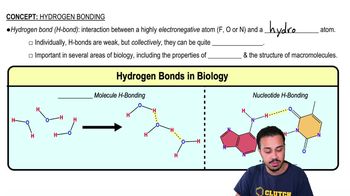
Hydrogen Bonding
23797
views
383
rank
1
comments
Termini in questo insieme (21)
Nascondere definizioni
Why is water considered a polar molecule?
Water has polarity because of polar covalent bonds between hydrogen and oxygen atoms, leading to partial positive and negative charges.
How does water's polarity affect biological molecules?
Water's polarity enables hydrogen bonding between and within biological molecules, influencing their structure and function.
What property of water helps maintain homeostatic body temperature?
Water has a high specific heat capacity, allowing it to absorb and release heat slowly, stabilizing body temperature.
How does water's high heat of vaporization benefit living organisms?
It allows evaporative cooling, helping organisms maintain body temperature by losing heat through water evaporation.
What causes cohesion, adhesion, and surface tension in water?
Hydrogen bonds between adjacent polar water molecules cause cohesion, adhesion, and surface tension.
Which elements are most prevalent in biological macromolecules?
Carbon, hydrogen, and oxygen are the most common elements in carbohydrates, proteins, lipids, and nucleic acids.
What roles do sulfur, phosphorus, and nitrogen play in biological molecules?
Sulfur is in proteins; phosphorus is in phospholipids and nucleic acids; nitrogen is in nucleic acids.
What is hydrolysis in biological macromolecules?
Hydrolysis breaks covalent bonds between monomers by adding water, splitting polymers into smaller units.
What is dehydration synthesis (condensation reaction)?
It joins two monomers by removing a water molecule, forming a covalent bond and building polymers.
What are monosaccharides and polysaccharides?
Monosaccharides are simple sugar monomers; polysaccharides are complex carbohydrates made of many monosaccharides.
Name three examples of polysaccharides.
Cellulose, starch, and glycogen are common polysaccharides.
What distinguishes saturated from unsaturated fatty acids?
Saturated fatty acids have only single carbon bonds; unsaturated fatty acids have one or more double bonds causing kinks.
How does the degree of unsaturation affect lipid properties?
More double bonds increase unsaturation, making lipids more liquid at room temperature.
List four functions or types of lipids in living organisms.
Fats store energy and provide insulation; steroids act as hormones; cholesterol stabilizes membranes; phospholipids form membranes.
What type of bond links amino acids in proteins?
Peptide bonds form covalent links between the carboxyl group of one amino acid and the amine group of another.
What are the components of an amino acid?
A central carbon bonded to a hydrogen, carboxyl group, amine group, and a variable R group.
How are amino acid R groups categorized?
R groups are hydrophobic/nonpolar, hydrophilic/polar, or ionic, affecting protein structure and function.
What determines the primary structure of a protein?
The specific sequence of amino acids in the polypeptide chain.
What forms the secondary structure of proteins?
Local folding via hydrogen bonds creates alpha-helices and beta-pleated sheets.
What interactions stabilize the tertiary structure of proteins?
Hydrogen bonds, hydrophobic interactions, ionic interactions, and disulfide bridges shape the 3D structure.
What is the quaternary structure of a protein?
The arrangement and interaction of multiple polypeptide chains forming a functional protein complex.
 IndietroIndietro
 05:03
