 Indietro
General Biology Core Concepts
 09:26

Termini in questo insieme (41)
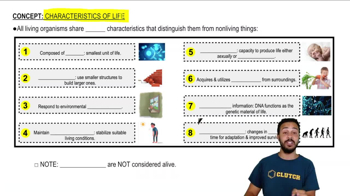
Cells, energy use, growth/development, reproduction, response to stimuli, homeostasis, and evolution/adaptation.
Observation → Question → Hypothesis → Experiment → Data → Conclusion.
An experiment where the variable being tested is changed while other conditions are controlled.
The variable that is changed by the researcher.
The variable that is measured.
A well-supported explanation based on evidence.
Larger sample sizes generally make data more reliable.
The result is unlikely to be due to random chance.
The idea that living things could arise from nonliving material.
The idea that microorganisms can cause disease.
A scientist whose work helped disprove spontaneous generation and establish Germ Theory.
Microorganisms came from the environment rather than spontaneously appearing.
Using controlled heat to reduce microorganisms.
They supported the use of antiseptic practices during surgery.
Protons, neutrons, and electrons.
Positive (+).
Neutral (0).
Negative (−).
The number of protons in an atom.
Protons + neutrons.
Atoms of the same element with different numbers of neutrons.
Electrons in the outermost shell.
A bond involving the transfer of electrons.
A bond involving the sharing of electrons.
A weak attraction involving hydrogen.
Electrons are shared unequally.
Water is polar, allowing it to interact with polar and charged substances.
A molecule containing carbon.
Carbohydrates, lipids, proteins, and nucleic acids.
Monosaccharides.
Amino acids.
Nucleotides.
A large molecule made from repeating smaller units called monomers.
A single sugar unit.
A molecule made of many sugar units.
A chain of amino acids.
Sugar, phosphate group, and nitrogenous base.
Hydrogen bonds.
A central carbon attached to an amino group, carboxyl group, hydrogen, and side group (R group).
The variable side group of an amino acid.
The sequence/order of amino acids.