Skip to main content
General Biology
Il mio corso
Impara
Preparazione agli esami
AI Tutor
Guide di studio
Soluzioni per libri di testo
Flashcard
Esplora
Prova l'app
Il mio corso
Impara
Preparazione agli esami
AI Tutor
Guide di studio
Soluzioni per libri di testo
Flashcard
Esplora
Prova l'app
Indietro
General Biology Core Concepts and Basics
Puoi toccare per girare la carta.
What is the core theme of biology?
Puoi toccare per girare la carta.
👆
What is the core theme of biology?
The core theme of biology is
Evolution
.
Avanzamenti del tracciato
I pulsanti di controllo sono stati cambiati in modalità "navigazione".
1/29
Video consigliati
09:50
Life's Organizational Hierarchy
28478
views
676
rank
10
comments
04:05
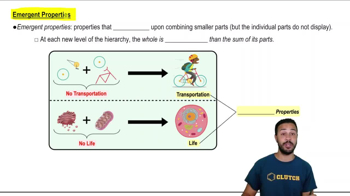
Emergent Properties
18505
views
449
rank
1
comments
03:05
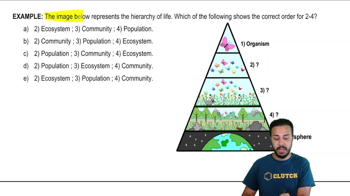
Life's Organizational Hierarchy Example 1
16538
views
462
rank
1
comments
Termini in questo insieme (29)
Nascondere definizioni
What is the core theme of biology?
The core theme of biology is
Evolution
.
What does the biological hierarchy include?
The biological hierarchy includes all life on Earth, compiled as the
biosphere
.
What is the central dogma of biology?
The central dogma is
DNA → RNA → Protein
.
What concept is illustrated when an enzyme loses its shape and can no longer catalyze a reaction?
This illustrates the relationship between
structure and function
.
What type of feedback loop involves a chemical signal leading to protein production, which then leads to more signals and protein?
This is an example of a
positive feedback loop
.
Which four elements make up 96% of living matter?
Oxygen, carbon, nitrogen, and hydrogen
.
What subatomic particle does the atomic number represent?
The atomic number corresponds to the number of
protons
.
What are atoms of the same element that differ in neutron number called?
They are called
isotopes
.
What is the mass number of a lithium atom with 3 protons and 4 neutrons?
The mass number is
7
(3 protons + 4 neutrons).
How many protons, neutrons, and electrons does sulfur have?
16 protons, 16 neutrons, and 16 electrons
.
Where are electrons found in an atom?
Electrons are found in
electron shells
or
electron orbitals
.
What are the outermost electrons called?
They are called
valence electrons
.
What determines the chemical behavior of an atom?
The number of
valence electrons
determines chemical behavior.
How many electrons can the first electron shell hold? How many in the last shell?
The first shell holds
2
electrons; the last shell typically holds
8
.
How many valence electrons does neon have?
Neon has
8 valence electrons
.
What type of chemical bond involves sharing a pair of electrons?
A
covalent bond
.
What type of bond forms when one atom transfers an electron to another?
An
ionic bond
.
What are examples of weak interactions between atoms?
Hydrogen bonding
and
Van der Waals interactions
.
What charge does an atom have after receiving an electron in an ionic bond?
It has a charge of
-1
.
Why do polar covalent bonds form?
Because one atom is more
electronegative
than the other.
What type of bond holds hydrogen and oxygen atoms together in a water molecule?
They are held by
polar covalent bonds
.
How do water molecules interact with each other?
Water molecules interact through
hydrogen bonds
.
Which two properties of water contribute to its upward movement in trees?
Cohesion
and
adhesion
.
What phenomenon allows water to cool bodies of water or organisms?
Evaporative cooling
.
What type of molecules dissolve most easily in water?
Ionic compounds
dissolve most easily.
What term describes the formation and breaking of chemical bonds?
Chemical reaction
.
What is chemical equilibrium?
A state where the formation and breaking of chemical bonds occur at equal rates.
What type of chemical bonds enable a gecko's ability to defy gravity?
Van der Waals interactions
.
What are two characteristics of a good hypothesis?
It must be
testable
and
falsifiable
.
 IndietroIndietro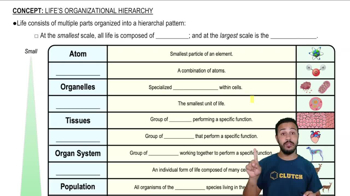
 09:50
09:50