 Indietro
General Biology: Early Animal Development and Body Plan Orientation
 12:48
12:48
Termini in questo insieme (19)
Cleavage is the series of rapid mitotic cell divisions of the zygote that leads to the formation of a multicellular embryo.
A blastula is a hollow ball of cells formed after cleavage, containing a fluid-filled cavity called the blastocoel.
Gastrulation is the process where the blastula reorganizes into a multilayered structure called the gastrula, forming germ layers.
The three germ layers are ectoderm, endoderm, and mesoderm (if present).
The blastopore is the opening formed during gastrulation that leads into the archenteron, the primitive gut.
The archenteron is the primitive gut cavity formed during gastrulation inside the embryo.
Radial symmetry is a body plan where body parts are arranged around a central axis, like spokes on a wheel.
Bilateral symmetry is a body plan with a single plane dividing the body into mirror-image left and right halves.
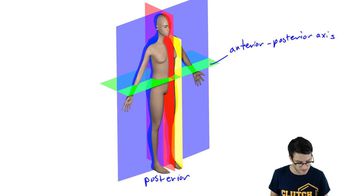
Key body axes include dorsal (back), ventral (belly), anterior (front), and posterior (rear).
The sagittal plane divides the body into left and right halves.
The frontal plane divides the body into dorsal (back) and ventral (belly) parts.
The transverse plane divides the body into anterior (front) and posterior (back) parts.
Dorsal refers to the back side, while ventral refers to the belly or underside of an animal.
Anterior is the front end, and posterior is the rear end of an animal's body.
The zygote is the fertilized egg cell that undergoes cleavage to start embryonic development.
The blastocoel is a fluid-filled cavity in the blastula that provides space for cell movement during gastrulation.
The ectoderm forms the outer layer of the embryo, giving rise to skin and nervous system.
The endoderm forms the inner layer, developing into the digestive tract and associated organs.
A single cell is the zygote, while two layers of cells represent early embryonic stages like the blastula with ectoderm and endoderm.