 Indietro
General Biology: Ecology Exam Review
 09:26
09:26
Termini in questo insieme (26)
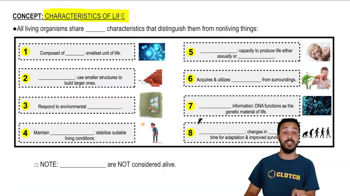
Living things grow, reproduce, respond to stimuli, maintain homeostasis, have metabolism, are made of cells, and evolve over time.
Biosphere is most inclusive: all ecosystems on Earth. Ecosystem includes communities plus abiotic factors. Community is all populations of different species in an area.
Molecules are least inclusive, as they are chemical structures. Cells make up organisms, which are individual living things.
Producers make their own food (e.g., plants). Consumers eat other organisms (e.g., animals). Decomposers break down dead matter (e.g., fungi).
Energy flows one-way and is lost as heat. Materials/nutrients cycle and are reused within the ecosystem.
Abiotic factors are nonliving components (e.g., temperature). Biotic factors are living components (e.g., plants, animals).
Water is stored in oceans, lakes, and groundwater. It returns to the atmosphere by evaporation and transpiration.
Plants photosynthesize to fix carbon. Primary consumers eat plants; secondary/tertiary consumers eat those consumers, transferring carbon.
Nitrogen-fixing bacteria convert N2 gas into usable forms via nitrogen fixation. Other bacteria perform nitrification and denitrification.
From bottom to top: Producers (autotrophs), primary consumers (herbivores), secondary consumers (carnivores), tertiary consumers (top predators).
Reduced primary consumers cause producer overgrowth and predator decline. Increased primary consumers reduce producers and may increase predators.
Lower latitude, moderate elevation, larger area, and older ecosystems generally have higher species diversity.
Fundamental niche is the full potential habitat a species can occupy. Realized niche is where it actually lives due to competition.
Two species competing for the same resource cannot coexist indefinitely; one will outcompete the other.
A species that has a disproportionately large effect on its ecosystem relative to its abundance.
Primary succession occurs on lifeless areas with no soil. Secondary succession occurs where a disturbance removed life but soil remains.
GPP: total energy captured by producers. NPP: energy after producers' respiration. SPP: energy available to consumers.
Commensalism: one benefits, other unaffected (e.g., barnacles on whales). Predation: one kills another. Parasitism: one benefits, other harmed. Mutualism: both benefit. Competition: both harmed.
Exponential growth shows unlimited growth. Logistic growth includes carrying capacity, leveling off as resources limit growth.
Density dependent: factors like disease, competition that depend on population size. Density independent: factors like weather, natural disasters.
The maximum population size an environment can sustain indefinitely.
Type I: high survival early, low late (e.g., humans). Type II: constant death rate (e.g., birds). Type III: high early mortality (e.g., fish).
Wide base = increasing population; narrow base = decreasing; uniform shape = stable population.
Can disrupt food webs, outcompete natives, introduce diseases, or alter habitats.
Greenhouse gases trap heat in the atmosphere, warming Earth. Increased gases cause climate change.
Habitat destruction, pollution, overhunting, invasive species, and climate change threaten biodiversity.