Skip to main content
General Biology
Il mio corso
Impara
Preparazione agli esami
AI Tutor
Guide di studio
Soluzioni per libri di testo
Flashcard
Esplora
Prova l'app
Il mio corso
Impara
Preparazione agli esami
AI Tutor
Guide di studio
Soluzioni per libri di testo
Flashcard
Esplora
Prova l'app
Indietro
General Biology: Energy and Enzymes
Puoi toccare per girare la carta.
What is the difference between anabolic and catabolic reactions?
Puoi toccare per girare la carta.
👆
What is the difference between anabolic and catabolic reactions?
Anabolic reactions
build molecules and require energy input (ATP).
Catabolic reactions
break down molecules and release energy (ATP).
Avanzamenti del tracciato
I pulsanti di controllo sono stati cambiati in modalità "navigazione".
1/24
Video consigliati
04:21
Thermodynamics: System vs. Surroundings
23547
views
380
rank
04:58
Introduction to Energy
31427
views
630
rank
2
comments
Termini in questo insieme (24)
Nascondere definizioni
What is the difference between anabolic and catabolic reactions?
Anabolic reactions
build molecules and require energy input (ATP).
Catabolic reactions
break down molecules and release energy (ATP).
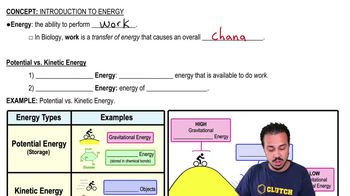
Define kinetic energy with examples.
Kinetic energy
is energy associated with motion. Examples include a person running and light energy from the sun.
What is potential energy and give examples?
Potential energy
is stored energy based on structure or position. Examples include chemical energy in food and energy from a proton gradient.
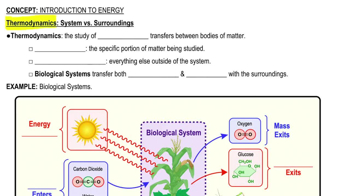
State the First Law of Thermodynamics.
Energy can be transferred or transformed but cannot be created or destroyed; the total energy of the universe is constant.
What does entropy measure?
Entropy
measures disorder or randomness. Low entropy means organized energy that can do work; high entropy means disorganized energy like heat.
Explain the Second Law of Thermodynamics.
When energy is converted, some is lost as heat, increasing the universe's entropy.
How do living organisms maintain order without violating the Second Law of Thermodynamics?
Organisms decrease entropy locally by increasing order but increase entropy in their surroundings by releasing heat and waste.
What is free energy (G) in biological systems?
Free energy is the energy available to do work in a cell.
What determines if a chemical reaction is spontaneous?
A reaction is spontaneous if the change in free energy (∆G) is negative.
Describe exergonic reactions.
Exergonic reactions release energy, have negative ∆G, are spontaneous, and are associated with catabolic pathways.
Describe endergonic reactions.
Endergonic reactions require energy input, have positive ∆G, are non-spontaneous, and are associated with anabolic pathways.
What is ATP composed of?
ATP consists of three phosphate groups, ribose sugar, and adenine nitrogenous base.
How does ATP release energy?
ATP releases energy by hydrolysis, breaking a phosphate bond to form ADP and inorganic phosphate.
How does ATP drive endergonic reactions?
ATP transfers a phosphate group to a reactant (phosphorylation), creating a phosphorylated intermediate that often changes protein shape.
What is activation energy (EA)?
Activation energy is the energy barrier that must be overcome to start a chemical reaction.
How do enzymes affect activation energy?
Enzymes lower the activation energy, speeding up reactions without changing ∆G.
What is the induced fit model of enzyme action?
The enzyme changes shape slightly to fit the substrate tightly at the active site, enhancing catalysis.
List factors that affect enzyme activity.
Substrate concentration, pH, temperature, salt concentration, cofactors, and inhibitors affect enzyme activity.
What are cofactors and coenzymes?
Cofactors are non-protein helpers like metal ions; coenzymes are organic molecules like vitamins that assist enzyme function.
Differentiate competitive and noncompetitive enzyme inhibitors.
Competitive inhibitors bind the active site competing with substrate; noncompetitive inhibitors bind elsewhere, changing enzyme shape.
What is allosteric regulation?
Allosteric regulation involves binding of activators or inhibitors at sites other than the active site, altering enzyme activity.
Explain cooperativity in enzymes.
Cooperativity is a form of allosteric regulation where binding of one substrate increases enzyme affinity for additional substrates.
What is feedback inhibition?
Feedback inhibition occurs when the end product of a metabolic pathway inhibits an earlier enzyme to prevent overproduction.
How does compartmentalization regulate metabolism?
Enzymes are localized in specific cell areas or organelles, organizing metabolic pathways and controlling reactions.
 IndietroIndietro
 04:21