Skip to main content
General Biology
Il mio corso
Impara
Preparazione agli esami
AI Tutor
Guide di studio
Soluzioni per libri di testo
Flashcard
Esplora
Prova l'app
Il mio corso
Impara
Preparazione agli esami
AI Tutor
Guide di studio
Soluzioni per libri di testo
Flashcard
Esplora
Prova l'app
Indietro
General Biology: Eukaryotic Cell Structure and Function
Puoi toccare per girare la carta.
What is the basic building block of living organisms?
Puoi toccare per girare la carta.
👆
What is the basic building block of living organisms?
The cell
is the basic building block of living organisms.
Avanzamenti del tracciato
I pulsanti di controllo sono stati cambiati in modalità "navigazione".
1/20
Video consigliati
04:26
Recap: Prokaryotic vs. Eukaryotic Cells
23379
views
407
rank
05:54
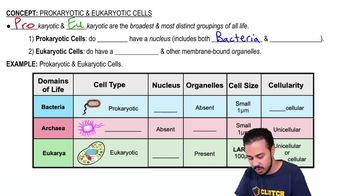
Prokaryotic & Eukaryotic Cells
39097
views
863
rank
4
comments
03:54
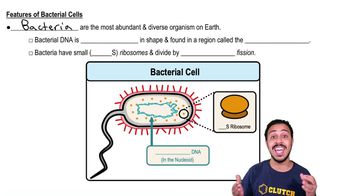
Features of Bacterial Cells
28311
views
505
rank
1
comments
Termini in questo insieme (20)
Nascondere definizioni
What is the basic building block of living organisms?
The cell
is the basic building block of living organisms.
What is an organelle?
An
organelle
is a membrane-bound body with a substantial lifetime in the cell, relatively permanent.
What is the primary role of the nucleus?
The nucleus stores DNA and transcribes it into RNA, which is used for protein synthesis.
What is the function of the nuclear pore complex (NPC)?
NPC stabilizes the nuclear envelope pore and allows passive diffusion of molecules smaller than ~40 kDa; larger molecules require specialized transport.
What are the main roles of the endoplasmic reticulum (ER)?
ER is responsible for protein synthesis (secreted and membrane-bound), lipid biosynthesis, and Ca++ storage.
What distinguishes rough ER from smooth ER?
Rough ER has ribosomes for protein synthesis; smooth ER lacks ribosomes and is involved in lipid metabolism and Ca++ storage.
What is the major function of the Golgi apparatus?
The Golgi apparatus processes proteins destined for the cell membrane or secretion.
What are the main roles of mitochondria?
Mitochondria generate NADH and ATP and are involved in apoptosis.
What is the cytoskeleton composed of?
The cytoskeleton is composed of microfilaments (actin), intermediate filaments, and microtubules (tubulin).
What is the role of microfilaments?
Microfilaments, made of actin, provide structural support and are involved in cell movement.
What is the role of intermediate filaments?
Intermediate filaments provide mechanical strength and help maintain cell shape.
What is the role of microtubules?
Microtubules, composed of tubulin, are dynamic structures involved in intracellular transport and cell division.
What is the extracellular matrix (ECM)?
The ECM is a network of proteins like collagen and fibronectin outside the cell that provides structural support and mediates cell signaling.
What is the primary component of plant cell walls?
Cellulose is the most characteristic component found in all plant cell walls.
What is the approximate width of a eukaryotic cell?
A eukaryotic cell is roughly 10-100 micrometers wide.
What is the function of ribosomes in the cell?
Ribosomes synthesize proteins by translating messenger RNA sequences into amino acid chains.
What is the role of the plasma membrane?
The plasma membrane controls the movement of substances in and out of the cell and facilitates communication.
What is apoptosis?
Apoptosis is programmed cell death, a process mitochondria help regulate.
What is the difference between passive diffusion and specialized nuclear transport?
Passive diffusion allows small molecules (<40 kDa) to cross the nuclear pore; larger molecules require active, specialized transport.
What is the role of the Golgi apparatus 'cis' and 'trans' faces?
The 'cis' face receives proteins from the ER; the 'trans' face ships processed proteins to their destinations.
 IndietroIndietro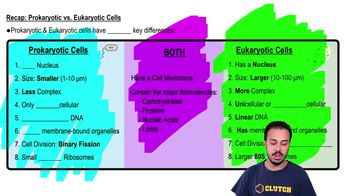
 04:26
04:26