 Indietro
General Biology: Evolution and Natural Selection
 07:48

Termini in questo insieme (43)
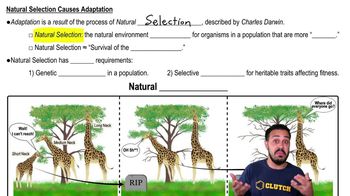
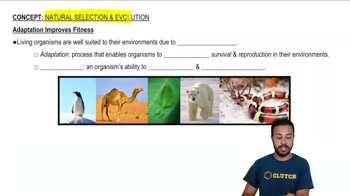
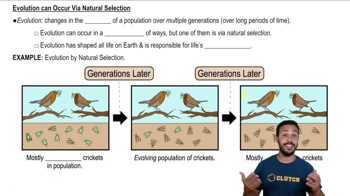
Species change over time by descent with modification. Natural selection is the mechanism driving evolutionary change.
Developed the binomial nomenclature system and hierarchical classification, helping organize species relationships.
Domain, Kingdom, Phylum, Class, Order, Family, Genus, Species.
Proposed that organisms evolve by inheritance of acquired traits through use and disuse.
Proposed uniformitarianism, suggesting Earth changes gradually over time, implying a much older Earth.
Observed species variation, fossils, and geographic distribution supporting evolution by natural selection.
Independently proposed natural selection as a mechanism for evolution, prompting Darwin to publish.
Fossils, endemic species, homologies (structural, developmental, molecular), transitional forms, and vestigial traits.
Provides chronological evidence of past life forms and evolutionary transitions.
Organisms buried in sediment, mineralization replaces organic material preserving shape.
Relative dating orders fossils by strata; absolute dating uses isotopes to determine exact age.
Measures radioactive decay of isotopes to calculate fossil age based on known half-life.
Half-life is the time for half of a radioactive isotope to decay; radiometric dating uses this to date fossils.
Variation exists; individuals with advantageous traits survive and reproduce more, changing population traits over time.
Overproduction, variation, competition, differential survival, and inheritance of traits.
Variation provides raw material for natural selection to act upon.
Artificial selection is human-driven breeding; natural selection is environmental pressures shaping traits.
Evolution occurs as changes in allele frequencies within populations, not individuals.
Change in allele frequencies within a population over time.
Mutation, gene flow, genetic drift, nonrandom mating, natural selection.
Random changes in allele frequencies, especially impactful in small, isolated populations.
Bottleneck effect and founder effect.
Alters genotype frequencies, can increase homozygosity and reduce genetic diversity.
Breeding among relatives increases homozygosity, often reducing fitness due to harmful recessive alleles.
Directional, stabilizing, disruptive, and balancing selection.
Heterozygotes have higher fitness than either homozygote, maintaining genetic variation.
Selection based on mate choice: intersexual (mate choice) and intrasexual (competition).
Gene flow introduces alleles between populations; mutation creates new alleles, both affecting evolution.
Biological, morphological, and phylogenetic species concepts.
Temporal, habitat, behavioral, mechanical, and gametic isolation preventing mating or fertilization.
Reduced hybrid viability and reduced hybrid fertility.
Allopatric: geographic isolation; sympatric: speciation without geographic barriers.
Autopolyploidy: chromosome duplication within species; allopolyploidy: hybridization between species.
Phylogeny is evolutionary history; tree depicts relationships among species.
Monophyletic includes ancestor and all descendants (natural grouping); others exclude some descendants or combine unrelated taxa.
Rapid diversification of species into new ecological niches.
Large-scale species loss opens niches, influencing evolution of survivors.
Earth ~4.6 billion years old; oldest fossils ~3.5 billion years, mainly prokaryotic stromatolites.
Produced oxygen, enabling aerobic life and ozone layer formation.
Likely via endosymbiosis of prokaryotes forming mitochondria and chloroplasts.
Occurred during the Cambrian explosion ~540 million years ago.
Plants and animals colonized land ~450 million years ago.
Asteroid impact evidenced by iridium layer and crater, causing mass extinction.