 Indietro
General Biology: Evolution and Population Genetics
 07:48
07:48
Termini in questo insieme (30)
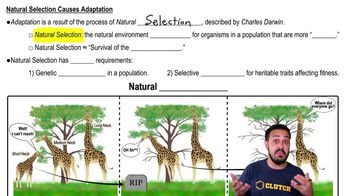
They independently developed the theory of evolution by natural selection. Darwin later provided extensive evidence and explanation for the mechanism.
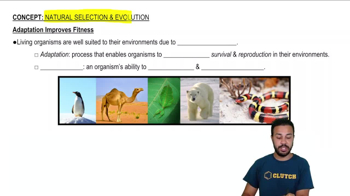
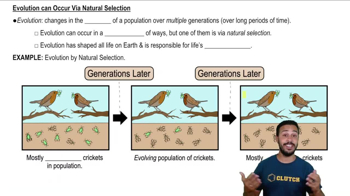
Organisms descend from common ancestors while accumulating changes over generations, resulting in the diversity of life.
Fossil record, biogeography, convergent evolution, direct observations of natural/artificial selection, and homologies.
Similarity between organisms due to shared ancestry.
Homologous: shared ancestry; Analogous: similar function but independent evolutionary origin.
A group of individuals of the same species living in the same area that can potentially interbreed.
Differences in genes or alleles among individuals within a population.
A model where allele and genotype frequencies remain constant from generation to generation in the absence of evolutionary forces.
No mutation, no gene flow, very large population, random mating, and no natural selection.
The sum of the frequencies of two alleles (p and q) in a population equals 1.
Selection favoring one extreme phenotype, shifting the population's traits toward that extreme.
Selection favoring the intermediate phenotype and selecting against both extremes.
Selection favoring both extreme phenotypes over the intermediate phenotype.
Selection that maintains multiple alleles or phenotypes within a population.
A random change in allele frequencies caused by chance, especially significant in small populations.
Genetic drift occurring when a population's size is drastically reduced, leaving a small random sample of the gene pool.
The movement of alleles between populations through migration and reproduction.
An individual's relative reproductive success, not physical strength.
A species is a group of populations whose members can interbreed and produce viable, fertile offspring and are reproductively isolated from others.
The inability of populations to successfully reproduce with one another, limiting gene flow and enabling speciation.
Prezygotic barriers (prevent fertilization) and postzygotic barriers (reduce hybrid survival or fertility).
Speciation resulting from geographic separation of populations.
Speciation occurring without geographic separation, often via polyploidy or ecological differentiation.
The theory that certain eukaryotic organelles originated as free-living prokaryotes engulfed by ancestral cells.
Mitochondria and chloroplasts, due to their own DNA, ribosomes, double membranes, and bacterial-like reproduction.
A method to estimate the absolute age of rocks or fossils using radioactive decay and half-life measurements.
A diagram representing a hypothesis about evolutionary relationships and common ancestry.
A group containing a common ancestor and all of its descendants.
Favor the evolutionary hypothesis requiring the fewest changes when comparing trees.
The two-part scientific naming system consisting of genus (capitalized) and specific epithet (lowercase), both italicized.