What is the significance of comparing nucleic acids or proteins in evolutionary studies?
Comparing nucleic acids or proteins helps infer relatedness through molecular homologies, revealing evolutionary history documented in genomes.
What are paralogous genes?
Paralogous genes result from gene duplication within a species and can evolve new functions over time.
What are orthologous genes?
Orthologous genes are homologous genes found in different species that diverge after speciation and usually retain similar functions.
How do molecular clocks estimate evolutionary time?
Molecular clocks use constant rates of nucleotide substitutions in genes to estimate the time since two genes or species shared a common ancestor.
What are some limitations of molecular clocks?
Molecular clocks can be irregular due to natural selection, mutation rate variation, and uncertainty in calibrations with fossil records.
What is horizontal gene transfer (HGT)?
HGT is the movement of genes between genomes by mechanisms like plasmid exchange, viral infection, or fusion, influencing evolution across domains.
How does natural selection increase the match between organisms and their environment?
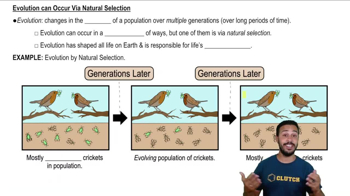
Natural selection favors individuals with advantageous heritable traits, increasing their survival and reproduction, leading to adaptation over time.
What is the difference between natural and artificial selection?
Natural selection occurs in nature based on environmental pressures, while artificial selection is human-driven breeding for desired traits.
What is genetic variation and why is it important for evolution?
Genetic variation is differences in heritable traits caused by different alleles; it provides the raw material for natural selection and evolution.
What are the main sources of genetic variation?
Genetic variation arises from mutations, gene duplications, and sexual reproduction through recombination of alleles.
What is a gene pool?
A gene pool is the total collection of alleles for all loci in a population.
Define allele frequency and how it is calculated in a diploid population.
Allele frequency is the proportion of a specific allele among all alleles at a locus; calculated as number of copies of the allele divided by total alleles.
State the Hardy-Weinberg equation and what it represents.
The equation \(p^2 + 2pq + q^2 = 1\) predicts genotype frequencies in a non-evolving population.
What are the five conditions required for Hardy-Weinberg equilibrium?
No mutations, random mating, no natural selection, extremely large population size, and no gene flow.
What does it mean if a population is not in Hardy-Weinberg equilibrium?
It suggests the population is evolving at that locus due to factors like selection, mutation, gene flow, genetic drift, or non-random mating.
How does natural selection differ from genetic drift and gene flow in causing evolution?
Natural selection causes adaptive evolution by favoring beneficial traits; genetic drift and gene flow cause allele frequency changes but not necessarily adaptation.
Explain the concept of microevolution.
Microevolution is the change in allele frequencies in a population over generations.
Why do mutations in gamete-producing cells matter for evolution?
Only mutations in gamete-producing cells can be passed to offspring and contribute to genetic variation in populations.
What role does sexual reproduction play in genetic variation?
Sexual reproduction shuffles existing alleles through recombination, creating new allele combinations important for adaptation.
How did Darwin's observations lead to the theory of natural selection?
Darwin observed heritable variation and overproduction of offspring, inferring that individuals with advantageous traits survive and reproduce more.
What is an example of natural selection observed in soapberry bugs?
Soapberry bugs evolved beak lengths matching the size of native or introduced fruits, showing rapid adaptation to food source changes.
How has antibiotic resistance in bacteria like MRSA evolved?
Bacteria with mutations conferring resistance survive antibiotic exposure and reproduce, increasing resistant allele frequency in the population.
What is the difference between paralogous and orthologous genes in terms of evolution?
Paralogous genes arise from duplication within a species and may evolve new functions; orthologous genes diverge after speciation and retain similar functions.
What is the significance of gene duplication in evolution?
Gene duplication increases gene number, providing raw material for new gene functions and evolutionary innovation.
How does the three-domain system classify life?
Life is classified into Bacteria, Archaea, and Eukarya based on genetic and molecular data.
What is the impact of horizontal gene transfer on the tree of life?
HGT blurs traditional lineage boundaries by transferring genes across domains, suggesting early life history is a tangled network.
 Indietro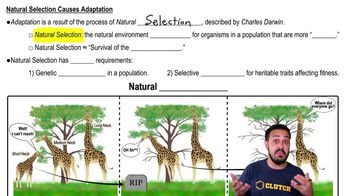
 07:48
07:48