 Indietro
General Biology: Evolution and Related Concepts
 03:22

Termini in questo insieme (16)
Strata are layers of sedimentary rock that provide a historical record of Earth's past environments and life forms.
Uniformitarianism is the principle that geological processes occurring today have operated similarly throughout Earth's history.
A fossil is the preserved remains or traces of ancient organisms found in strata.
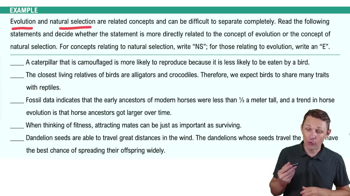
Natural selection is the process where organisms better adapted to their environment tend to survive and produce more offspring.
Evolution is the change in the heritable traits of biological populations over successive generations.
Homologous structures are anatomical features in different species that share a common ancestry but may have different functions.
Comparative embryology studies similarities and differences in the embryos of different species to understand evolutionary relationships.
Vestigial structures are anatomical features that have lost their original function through evolution.
Endemic species are those native to and restricted to a specific geographic area.
Pangaea was a supercontinent that existed during the late Paleozoic and early Mesozoic eras before breaking apart into current continents.
Wallace was a naturalist who independently conceived the theory of evolution by natural selection alongside Darwin.
Biogeography is the study of the geographic distribution of species and ecosystems over time.
Artificial selection is the human-directed breeding of organisms to produce desired traits.
Analogy refers to similar traits due to convergent evolution, while homology refers to traits inherited from a common ancestor.
Embryonic homologies are similarities in early developmental stages among different species indicating common ancestry.
Molecular homologies involve similarities in DNA or protein sequences; structural homologies involve anatomical similarities from common descent.