 Indietro
General Biology: Evolution and Speciation Study Guide
 07:48
07:48
Termini in questo insieme (30)
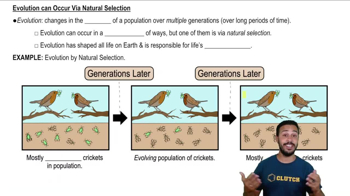
Evolution is the change in the inherited characteristics of populations over generations.
All living things are related through common ancestry, and descendants differ from ancestors because traits change over generations.
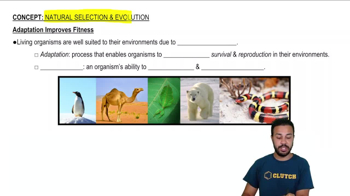
An inherited trait that increases an organism's ability to survive and reproduce in a particular environment.
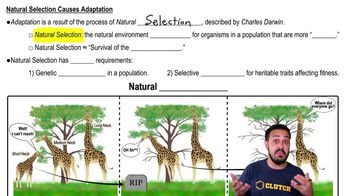
A process where individuals with heritable traits that improve survival or reproduction tend to leave more offspring, making those traits more common.
Human-directed selection where people choose which organisms reproduce based on desired traits.
A body structure similar due to common ancestry, even if it has different functions in different organisms.
A reduced structure inherited from an ancestor that has little or no important function in the organism today.
When unrelated organisms independently evolve similar traits due to similar environmental pressures.
The collection of preserved remains and traces of past organisms documenting life through geologic time.
The study of where organisms are found geographically and how those patterns relate to evolution.
A change in allele frequencies in a population over generations.
Random changes in allele frequencies caused by chance events.
Genetic drift occurring when a small group starts a new population carrying only part of the original genetic variation.
Genetic drift occurring when a population is drastically reduced in size, leaving a small and unrepresentative set of survivors.
Movement of alleles between populations through migration and reproduction.
A model where allele and genotype frequencies remain constant from generation to generation if five conditions are met.
Very large population, random mating, no mutation, no gene flow, and no natural selection.
Selection that favors one extreme phenotype, shifting the population toward that extreme.
Selection that favors both extreme phenotypes over intermediate ones.
Selection that favors intermediate phenotypes and selects against both extremes.
Selection for traits that increase an individual's success in obtaining mates.
A species is a group of natural populations whose members can interbreed and produce viable, fertile offspring and are reproductively isolated from other groups.
When populations cannot successfully produce viable, fertile offspring with one another.
Reproductive barriers that prevent fertilization, including habitat, temporal, behavioral, mechanical, and gametic isolation.
Reproductive barriers acting after fertilization that reduce hybrid survival or reproduction, such as reduced viability, reduced fertility, and hybrid breakdown.
Speciation that begins when populations are geographically separated.
Speciation that occurs without geographic separation, often through mechanisms like polyploidy or sexual selection.
Having more than two complete sets of chromosomes, which can lead to speciation.
A geographic region where genetically different populations or species meet and produce hybrids.
A pattern of long periods of little evolutionary change interrupted by relatively rapid evolutionary change, often around speciation events.