 Indietro
General Biology Exam 1 Key Concepts
 09:50
09:50
Termini in questo insieme (31)
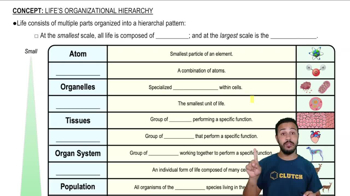
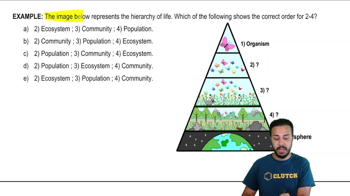
Molecule → Organelle → Cell → Tissue → Organ → Organ System → Organism → Population → Community → Ecosystem → Biosphere
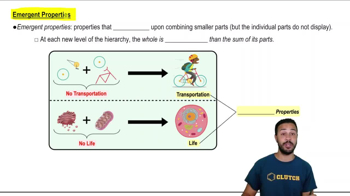
New functions that arise at higher levels of biological organization from interactions among components.
The cell is the basic structural and functional unit of life.
Populations have heritable variation; individuals with favorable traits survive and reproduce more; beneficial traits become more common over generations.
Observation, Hypothesis, Prediction, Experiment, Analysis, Conclusion.
The scientific study of life.
An inherited trait that improves survival and reproduction.
Process by which advantageous traits become more common in a population.
All regions of Earth where life exists.
A community of organisms plus their physical environment.
Members of the same species living in the same area.
A testable explanation for an observation.
A broad explanation supported by extensive evidence.
Anything that has mass and occupies space.
A pure substance that cannot be broken down chemically.
Carbon, Hydrogen, Oxygen, Nitrogen (CHON).
Protons (+) and Neutrons (0) in nucleus; Electrons (-) in electron cloud.
Electrons in the outermost shell that determine bonding behavior.
Bond formed by sharing electrons between atoms.
Bond formed by transfer of electrons and attraction between oppositely charged ions.
Weak attraction between polar molecules, important in water properties.
Oxygen attracts shared electrons more strongly, creating partial negative charge (δ-) on oxygen and partial positive charge (δ+) on hydrogen.
Attraction between water molecules due to hydrogen bonding.
Attraction between water molecules and other surfaces.
Resistance of water's surface to breaking due to cohesion.
Water temperature changes slowly because hydrogen bonds absorb heat.
Ice is less dense than liquid water, so it floats.
Measures acidity: <7 acidic, =7 neutral, >7 basic.
Substance that increases H⁺ concentration in solution.
Substance that decreases H⁺ concentration in solution.
Substance that stabilizes pH by resisting changes in H⁺ concentration.