 Indietro
General Biology Exam 1 Key Concepts
 09:26

Termini in questo insieme (30)
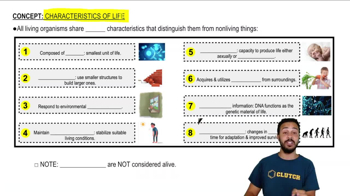
Order, regulation, growth and development, energy processing, response to environment, reproduction, and evolutionary adaptation.
A hypothesis is a testable explanation; a prediction is a specific expected outcome if the hypothesis is true.
A controlled variable is a factor kept constant to ensure that only the independent variable affects the outcome.
Diffusion is the passive movement of molecules from an area of higher concentration to lower concentration.
Osmosis is the diffusion of water across a selectively permeable membrane.
Active transport uses energy to move substances against their concentration gradient.
It creates an ion gradient by pumping 3 Na+ out and 2 K+ into the cell using ATP.
The membrane is a fluid bilayer of phospholipids with embedded proteins forming a mosaic structure.
Saturated fatty acids have no double bonds; unsaturated fatty acids have one or more double bonds causing kinks.
A monomer is a single building block; a polymer is a chain of monomers linked together.
Lipids are not polymers because they are not made of repeating monomer units but of different components like glycerol and fatty acids.
The primary structure is the linear sequence of amino acids in a polypeptide chain.
Local folding into alpha helices and beta sheets stabilized by hydrogen bonds.
The overall 3D shape of a single polypeptide formed by interactions among side chains.
Assembly of multiple polypeptide subunits into a functional protein complex.
Ribose has a hydroxyl group on the 2' carbon; deoxyribose lacks this hydroxyl (has H instead).
Covalent bond linking the 3' carbon of one nucleotide sugar to the 5' phosphate of the next in nucleic acids.
Microvilli increase surface area to enhance nutrient absorption in the small intestine.
Tight junctions seal cells together to prevent leakage and maintain selective permeability.
Absorption rate increases with surface area and concentration gradient, decreases with membrane thickness.
Carrier proteins bind and change shape to transport molecules; channel proteins form pores for passive flow.
CCK stimulates release of digestive enzymes from the pancreas and bile from the gallbladder.
Gastrin stimulates secretion of gastric acid (HCl) in the stomach.
Membrane property allowing some substances to cross more easily than others.
Prokaryotes lack membrane-bound organelles; eukaryotes have a nucleus and organelles.
Mitochondria generate ATP through cellular respiration.
Modifies, sorts, and packages proteins and lipids for secretion or delivery to organelles.
Vesicles fuse with the plasma membrane to release contents outside the cell.
Breaking down molecules by adding water, often during digestion.
Joining molecules by removing water, forming covalent bonds.