 Indietro
General Biology Exam 1 Review
 09:50

Termini in questo insieme (30)
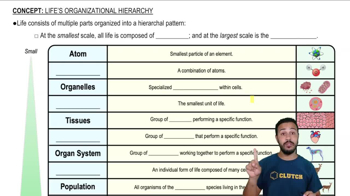
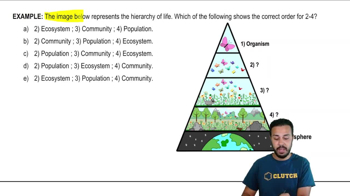
The organization of life from largest to smallest, starting with the biosphere (Earth) down to ecosystems, communities, populations, organisms, organs, tissues, cells, organelles, and molecules.
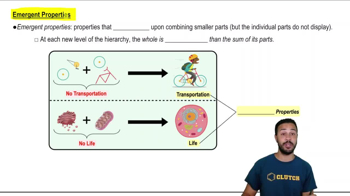
New properties that arise at each level of biological organization due to interactions among components.
The cell is the smallest unit of life capable of independent existence and performing all life functions.
Prokaryotic cells lack a nucleus and membrane-bound organelles; eukaryotic cells have a nucleus and organelles.
DNA is composed of nucleotides with a sugar-phosphate backbone and nitrogenous bases; it forms chromosomes.
A segment of DNA that codes for a specific protein or RNA molecule.
The building blocks of DNA and RNA, consisting of a sugar, phosphate group, and nitrogenous base.
The repeating chain of sugar and phosphate groups that forms the structural framework of DNA.
The process by which information from a gene is used to synthesize functional gene products like proteins.
Energy flows through an ecosystem from producers to consumers and is lost as heat; nutrients cycle within the system.
Producers make their own food via photosynthesis; consumers obtain energy by eating other organisms.
The process of change in populations over generations, explaining unity and diversity of life.
Bacteria, Archaea (both prokaryotes), and Eukarya (eukaryotes); classified by cell type and genetics.
The mechanism of evolution proposed by Charles Darwin where organisms better adapted to their environment survive and reproduce.
Observation, hypothesis, prediction, experiment, analysis, and conclusion.
A hypothesis is a testable prediction; a theory is a well-supported explanation of natural phenomena.
Inductive reasoning derives generalizations from observations; deductive reasoning predicts specific results from general principles.
Atoms consist of protons and neutrons in the nucleus, with electrons in orbitals around the nucleus.
Energy levels around an atom's nucleus where electrons reside; determine chemical reactivity.
Ionic, covalent (polar and nonpolar), hydrogen bonds, and van der Waals interactions.
The tendency of an atom to attract electrons in a chemical bond, influencing bond polarity.
Polar molecules have uneven charge distribution (hydrophilic); nonpolar molecules have even charge (hydrophobic).
Water is polar, has high specific heat, evaporative cooling, ice floats due to hydrogen bonding, and is the solvent of life.
Acids increase H+ concentration; bases increase OH- concentration; pH measures acidity or alkalinity.
Carbon-based molecules including carbohydrates, lipids, proteins, and nucleic acids.
Macromolecules are large molecules; polymers are chains of monomers; monomers are single units.
Dehydration builds polymers by removing water; hydrolysis breaks polymers by adding water.
Primary (sequence), secondary (alpha helices, beta sheets), tertiary (3D folding), quaternary (multiple polypeptides).
Loss of protein structure and function due to environmental changes like temperature or pH.
DNA stores genetic info; RNA is involved in protein synthesis; differ in sugar (deoxyribose vs ribose) and bases.