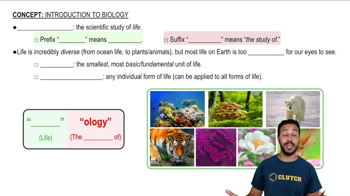
An approach to studying biology that focuses on complex interactions within biological systems.
What defines a cell in biology?
The smallest unit that can carry out all attributes of life; living things are made of cells.
Difference between eukaryotic and prokaryotic cells?
Eukaryotic cells have a nucleus and membrane-bound organelles; prokaryotic cells do not.
What is the role of DNA in life processes?
DNA is the genetic material that stores information for synthesizing polypeptides and is transmitted across generations.
Define genomics and proteomics.
Genomics studies genes of species; Proteomics studies proteins and their properties.
What is bioinformatics?
The use of computers to analyze and interpret biological data.
How does energy flow and nutrients cycle in ecosystems?
Energy flows through ecosystems; nutrients cycle within ecosystems; producers play a key role.
Name three types of symbiotic relationships.
Mutualism, Commensalism, and Parasitism.
What is negative feedback in biological systems?
A process where a molecule shuts off its own production to maintain homeostasis, e.g., glucose regulation by insulin.
What is positive feedback? Give examples.
A process that amplifies a response, less common; examples include blood clotting and uterine contractions during childbirth.
What is evolution's role in biology?
Evolution explains the unity and diversity of life through species adapting to fill biological niches.
What are the three domains of life?
Bacteria, Archaea, and Eukarya.
What is taxonomy?
The naming and classification of living things, including ranks like domain, kingdom, phylum, class, order, family, genus, species.
What is a hypothesis?
A testable if...then statement used to make predictions in scientific inquiry.
Difference between inductive and deductive reasoning?
Inductive reasoning moves from specific observations to general conclusions; deductive reasoning moves from general principles to specific predictions.
What are independent, dependent variables, constants, and controls in experiments?
Independent variable: manipulated; Dependent variable: measured; Constants: kept the same; Control: baseline for comparison.
What is an element and an atom?
An element is a substance that cannot be broken down; an atom is the smallest unit of an element.
What are the subatomic particles of an atom?
Protons (+), Neutrons (neutral), and Electrons (-).
What are valence electrons?
Electrons in the outermost shell available to participate in chemical bonding.
Difference between covalent and ionic bonds?
Covalent bonds share electrons (polar or nonpolar); ionic bonds transfer electrons forming salts like NaCl.
What are hydrogen bonds and Van der Waals interactions?
Weak interactions; hydrogen bonds form between polar molecules; Van der Waals are weak attractions due to transient charges.
What are the four emergent properties of water?
Cohesion, Specific heat, Evaporative cooling, and Solvent properties.
 Indietro
 02:09
02:09