 Indietro
General Biology Exam 1 Study Guide
 04:26
04:26
Termini in questo insieme (31)
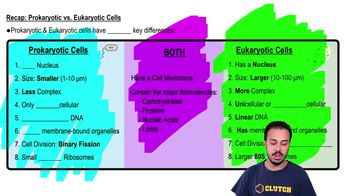
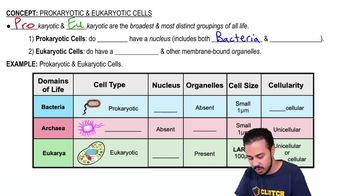
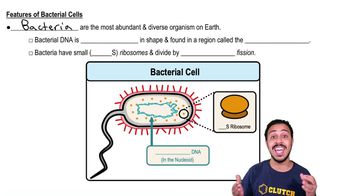
Prokaryotic cells lack a nucleus and membrane-bound organelles; eukaryotic cells have a nucleus and organelles.
Both have plasma membranes, cytoplasm, ribosomes, and DNA as genetic material.
Plant cells have a cell wall, chloroplasts, and large central vacuoles; animal cells do not.
DNA is transcribed into RNA, which is translated into protein.
Positive regulation activates gene expression; negative regulation represses gene expression.
Energy flows from producers to consumers and is lost as heat at each trophic level.
Atoms are most stable when their outer electron shells are full.
Electrons in the outermost shell that determine an atom's chemical reactivity.
Atoms with incomplete valence shells are reactive; those with full shells are inert.
Atomic number = number of protons; mass number = protons + neutrons.
Protons = atomic number; neutrons = mass number - atomic number; electrons = protons ± charge.
State where forward and reverse reaction rates are equal, so concentrations remain constant.
Covalent (polar and nonpolar), ionic, and hydrogen bonds.
Acids donate H+; bases accept H+.
pH = -log[H+]; lower pH means higher H+ concentration.
A buffer resists pH changes by neutralizing added acids or bases.
Each pH unit represents a tenfold change in H+ concentration.
Cohesion, high surface tension, density, and solvent ability.
Specific groups of atoms that confer characteristic properties to molecules.
Structural isomers, cis-trans isomers, and enantiomers.
Carbohydrates, proteins, and nucleic acids are true polymers; lipids are not.
Dehydration links monomers by removing water; hydrolysis breaks polymers by adding water.
Glycosidic bonds in carbohydrates, peptide bonds in proteins, phosphodiester bonds in nucleic acids.
Cellulose is indigestible due to beta glycosidic linkages.
Primary, secondary, tertiary, and quaternary structures held by peptide bonds, hydrogen bonds, hydrophobic interactions, and disulfide bridges.
Examples include Alzheimer's, Parkinson's, and prion diseases.
Nonpolar side chains cluster away from water, stabilizing protein structure.
Central carbon, amino group, carboxyl group, hydrogen atom, and variable R group.
Saturated fats have no double bonds; unsaturated fats have one or more double bonds.
DNA has deoxyribose sugar and thymine; RNA has ribose sugar and uracil.
Presence of thymine indicates DNA; uracil indicates RNA.