Skip to main content
General Biology
Il mio corso
Impara
Preparazione agli esami
AI Tutor
Guide di studio
Soluzioni per libri di testo
Flashcard
Esplora
Prova l'app
Il mio corso
Impara
Preparazione agli esami
AI Tutor
Guide di studio
Soluzioni per libri di testo
Flashcard
Esplora
Prova l'app
Indietro
General Biology Exam 1 Study Guide
Puoi toccare per girare la carta.
Biological community
Puoi toccare per girare la carta.
👆
Biological community
A group of interacting populations of different species living together in a defined area.
Avanzamenti del tracciato
I pulsanti di controllo sono stati cambiati in modalità "navigazione".
1/31
Video consigliati
01:35
Scientific Method Example 1
13143
views
297
rank
03:03
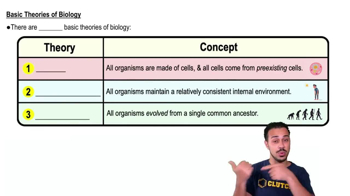
Basic Theories of Biology
13920
views
289
rank
1
comments
06:29
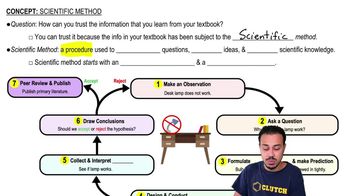
Scientific Method
22106
views
525
rank
1
comments
Termini in questo insieme (31)
Nascondere definizioni
Biological community
A group of interacting populations of different species living together in a defined area.
Prokaryotes
Organisms without a nucleus, including bacteria and archaea.
Eukarya
Domain of organisms with cells that contain a nucleus, including plants, animals, and fungi.
Reductionism
Approach of studying complex systems by breaking them down into simpler components.
Flow of energy through an ecosystem
Energy flows from the sun to producers, then to consumers, and finally to decomposers, with energy lost as heat.
Origin of oxygen in Earth's atmosphere
Oxygen originated from photosynthetic organisms releasing O2 as a byproduct.
Charles Darwin's contribution
Proposed natural selection as the mechanism for evolution, explaining unity and diversity of life.
Scientific hypothesis
A testable and falsifiable explanation for a scientific question.
Controlled experiment
An experiment where only one variable is changed while others are kept constant.
Qualitative vs Quantitative data
Qualitative data describes qualities; quantitative data involves numerical measurements.
Covalent bonding
Chemical bond formed by sharing electron pairs between atoms.
Polar covalent bonding
A covalent bond where electrons are shared unequally, causing partial charges.
Ionic bonding
Chemical bond formed by the transfer of electrons, creating oppositely charged ions.
Hydrogen bonding
Weak attraction between a hydrogen atom and an electronegative atom like oxygen or nitrogen.
Van der Waals interactions
Weak, short-range forces between uncharged molecules due to transient dipoles.
Daltons
Unit of atomic mass approximately equal to the mass of one proton or neutron.
Hydrophilic vs Hydrophobic
Hydrophilic molecules interact with water; hydrophobic molecules repel water.
Four most abundant elements in the human body
Oxygen, carbon, hydrogen, and nitrogen.
Parts of an atom
Protons (positive), neutrons (neutral), electrons (negative).
Valence electrons
Electrons in the outermost shell involved in chemical bonding.
Chemical equilibrium
State where forward and reverse reactions occur at the same rate.
Acids, bases, buffers
Acids donate H+ ions; bases accept H+ ions; buffers resist pH changes.
pH scale range and strong vs weak acids
pH ranges from 0 to 14; strong acids dissociate completely, weak acids partially.
Hydrolysis reaction
Chemical reaction that breaks bonds by adding water.
Dehydration reaction
Chemical reaction that forms bonds by removing water.
Protein structures: primary, secondary, tertiary
Primary: amino acid sequence; secondary: alpha helices and beta sheets; tertiary: 3D folding.
Peptide bonds
Covalent bonds linking amino acids in a protein.
Cellulose and chitin
Structural polysaccharides; cellulose in plants, chitin in fungi and exoskeletons.
Saturated vs unsaturated fats
Saturated fats have no double bonds; unsaturated fats have one or more double bonds.
Functional groups in amino acids
Amino group (-NH2) and carboxyl group (-COOH) are always present.
Nitrogenous bases in DNA and RNA
Adenine, thymine (DNA only), uracil (RNA only), cytosine, guanine; A pairs with T or U, C pairs with G.
 IndietroIndietro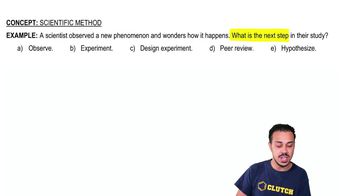
 01:35
01:35