Indietro

General Biology Exam 1 Study Guide

I pulsanti di controllo sono stati cambiati in modalità "navigazione".
1/37
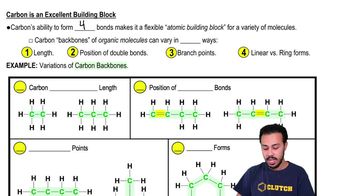
  • Why is carbon important in biological molecules?

    Carbon has four valence electrons allowing it to form four covalent bonds, enabling the creation of diverse biological molecules.
  • What defines an organic compound?

    Organic compounds contain carbon and form the basis of life.
  • What are isomers?

    Molecules with the same molecular formula but different structures or arrangements of atoms.
  • Name the main functional groups and one key function each.

    • Hydroxyl (-OH): makes molecules polar
    • Carbonyl (C=O): found in sugars
    • Carboxyl (-COOH): acts as an acid
    • Amino (-NH₂): acts as a base
    • Sulfhydryl (-SH): stabilizes proteins
    • Phosphate (-PO₄): energy transfer (ATP)
    • Methyl (-CH₃): influences gene expression
  • What is the difference between a monomer and a polymer?

    Monomer is a small building block; polymer is a large molecule made of repeating monomers.
  • What reactions build and break down polymers?

    Dehydration (condensation) removes water to join monomers; hydrolysis adds water to break polymers into monomers.
  • What are the main functions of carbohydrates?

    Provide immediate energy, energy storage, and structural support.
  • What is the general formula for carbohydrates?

    Carbohydrates have the general ratio \((CH_2O)_n\).
  • Name three types of carbohydrates and an example of each.

    • Monosaccharides: glucose
    • Disaccharides: sucrose (glucose + fructose)
    • Polysaccharides: starch (plant energy storage)
  • What distinguishes saturated from unsaturated fats?

    Saturated fats have no double bonds and are solid at room temperature; unsaturated fats have one or more double bonds and are liquid at room temperature.
  • What is the structure and function of phospholipids?

    Phospholipids have a hydrophilic phosphate head and two hydrophobic fatty acid tails; they form the plasma membrane bilayer.
  • What are the four levels of protein structure?

    • Primary: amino acid sequence
    • Secondary: α-helix and β-pleated sheet
    • Tertiary: overall 3D shape
    • Quaternary: multiple polypeptide chains
  • What causes protein denaturation and what is its effect?

    Denaturation is caused by heat, extreme pH, or chemicals and results in loss of protein shape and function.
  • What are the main functions of nucleic acids?

    Store genetic information and direct protein synthesis.
  • What are the components of a nucleotide?

    A nucleotide contains a phosphate group, a sugar, and a nitrogenous base.
  • How do DNA and RNA differ in sugar and bases?

    DNA contains deoxyribose and bases A, T, G, C; RNA contains ribose and bases A, U, G, C.
  • What is the cell theory?

    1. All living organisms are composed of cells.
    2. The cell is the basic unit of structure and function.
    3. All cells arise from preexisting cells.
  • Key differences between prokaryotic and eukaryotic cells?

    Prokaryotes have no nucleus or membrane-bound organelles; eukaryotes have a nucleus and organelles.
  • What is the structure and function of the plasma membrane?

    A phospholipid bilayer with proteins, cholesterol, and carbohydrates; it separates the cell from the environment and regulates substance movement.
  • What is the function of ribosomes and their two types?

    Ribosomes synthesize proteins; free ribosomes make proteins for inside the cell, bound ribosomes make proteins for export or membranes.
  • Functions of rough and smooth endoplasmic reticulum (ER)?

    Rough ER: protein production and modification; Smooth ER: lipid synthesis, detoxification, calcium storage.
  • What is the role of the Golgi apparatus?

    Modifies, sorts, and packages proteins for transport.
  • What are lysosomes and their function?

    Organelles containing hydrolytic enzymes that digest food, bacteria, and damaged organelles.
  • What is the function of mitochondria?

    Perform cellular respiration to produce ATP, the cell's energy currency.
  • What is the function of chloroplasts in plant cells?

    Convert sunlight into chemical energy via photosynthesis.
  • What are microtubules and microfilaments in the cytoskeleton?

    Microtubules provide cell shape and tracks for organelle movement; microfilaments support cell contraction and shape.
  • Difference between cilia and flagella?

    Cilia are short and numerous, moving fluid across surfaces; flagella are long and few, propelling the cell.
  • What are the main differences between plant and animal cells?

    Plant cells have a cell wall, chloroplasts, and a large central vacuole; animal cells lack these but have centrioles and lysosomes.
  • Endomembrane System


    A group of organelles that work together to produce, modify, and transport molecules.

    Golgi apparatus, Lysosomes

  • Amino acids join via


    Peptide bonds

  • Amino Acids


    Amino group, Carboxyl group, Hydrogen, Variable R group (different R groups)

  • Protein function


    Enzymes, Structure, transport

  • Steroids


    Important in signaling and membrane function

  • Lipids


    1 glycerol, 3 fatty acid

  • Macromolecules


    large organic molecules essential for life. Most are built from smaller

    repeating units called monomers.

  • Cis-Trans Isomers


    different spatial arrangments and double bonds

  • Enantiomers


    mirror image