 Indietro
General Biology Exam 1 Study Guide
 09:26
09:26
Termini in questo insieme (30)
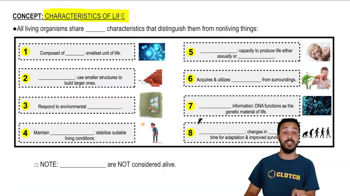
Living organisms share key traits such as cellular organization, metabolism, growth, reproduction, response to stimuli, and homeostasis.
The cell is the smallest fundamental unit of structure and function in living organisms.
Order from smallest to largest: atom → molecule → organelle → cell → tissue → organ → organ system → organism → population → community → ecosystem → biosphere.
Population: same species in an area.
Community: multiple species populations.
Ecosystem: community plus nonliving environment.
Bacteria and Archaea are prokaryotic; Eukarya includes eukaryotic organisms.
Observation/question → hypothesis → prediction → testing/experimentation → analysis → conclusion.
A testable and falsifiable explanation or prediction based on theory, investigated through experimentation.
1. All living organisms are made of cells.
2. Cell is basic unit of structure and function.
3. All cells come from pre-existing cells.
Cells contain DNA, have similar chemical composition, and energy flow (metabolism) occurs within cells.
Atoms consist of protons (positive), neutrons (neutral), and electrons (negative).
The number of protons in an atom determines its atomic number and element identity.
Atoms of the same element with different numbers of neutrons.
Electrons in the outermost shell that participate in chemical bonding.
Atoms share pairs of valence electrons; can be nonpolar (equal sharing) or polar (unequal sharing).
Attraction between oppositely charged ions formed by electron transfer.
Weak attractions between a hydrogen attached to an electronegative atom and another electronegative atom; important in water properties.
Oxygen is more electronegative than hydrogen, causing unequal electron sharing and partial charges.
Groups like amino, carboxyl, hydroxyl, and phosphate influence chemical properties of organic molecules.
Carbohydrates, lipids, proteins, and nucleic acids.
Monomers are single units; polymers are chains of monomers joined by dehydration reactions.
Dehydration builds polymers by removing water; hydrolysis breaks polymers by adding water.
Diverse, mostly nonpolar organic compounds that do not dissolve in water; include fats, membrane lipids, and steroids.
One glycerol backbone bonded to three fatty acids via dehydration reactions.
Saturated: no double bonds, solid at room temp.
Unsaturated: one or more double bonds, liquid at room temp.
Contain hydrophilic heads and hydrophobic tails, allowing formation of lipid bilayers and micelles.
Characterized by a four-ring hydrocarbon skeleton, distinct from triglycerides and phospholipids.
Monosaccharides: single sugars.
Disaccharides: two sugars.
Polysaccharides: long sugar chains.
The covalent bond joining monosaccharides in carbohydrates.
Energy storage, structural support, and cell identity/signaling.
Starch: plant energy storage.
Glycogen: animal energy storage.
Cellulose: plant structural support.
Chitin: arthropod exoskeletons.