Skip to main content
General Biology
Il mio corso
Impara
Preparazione agli esami
AI Tutor
Guide di studio
Soluzioni per libri di testo
Flashcard
Esplora
Prova l'app
Il mio corso
Impara
Preparazione agli esami
AI Tutor
Guide di studio
Soluzioni per libri di testo
Flashcard
Esplora
Prova l'app
Indietro
General Biology Exam 1 Study Guide
Puoi toccare per girare la carta.
Properties of living organisms
Puoi toccare per girare la carta.
👆
Properties of living organisms
Living organisms have properties such as growth, reproduction, response to stimuli, metabolism, homeostasis, and cellular organization.
Avanzamenti del tracciato
I pulsanti di controllo sono stati cambiati in modalità "navigazione".
1/35
Video consigliati
09:26
Characteristics of Life
44688
views
1282
rank
9
comments
02:59
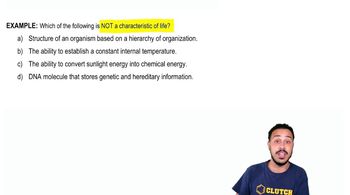
Characteristics of Life Example 1
25597
views
788
rank
4
comments
Termini in questo insieme (35)
Nascondere definizioni
Properties of living organisms
Living organisms have properties such as growth, reproduction, response to stimuli, metabolism, homeostasis, and cellular organization.
Relationship between structure and function in living things
The structure of a biological component is closely related to its function, meaning form fits function.
Smallest unit of life
The cell is the smallest unit of life capable of performing all life functions.
Difference between prokaryotic and eukaryotic cells
Prokaryotic cells lack a nucleus and membrane-bound organelles; eukaryotic cells have a nucleus and organelles.
Three domains of life
The three domains are Bacteria, Archaea, and Eukarya; animals and plants belong to Eukarya.
Four elements making up 96% of living matter
Carbon, hydrogen, oxygen, and nitrogen make up 96% of living matter.
Trace elements examples
Examples of trace elements include iron (Fe) and iodine (I).
Element vs compound
An element is a pure substance of one type of atom; a compound is a substance made of two or more elements chemically combined.
Subatomic particles and their properties
Protons (positive charge), neutrons (neutral), and electrons (negative charge) make up atoms.
Atomic number vs mass number
Atomic number is the number of protons; mass number is the sum of protons and neutrons.
Isotopes similarity and difference
Isotopes have the same number of protons but different numbers of neutrons.
Nonpolar covalent, polar covalent, and ionic bonds
Nonpolar covalent bonds share electrons equally; polar covalent bonds share unequally; ionic bonds transfer electrons.
Single vs double bonds
Single bonds share one pair of electrons; double bonds share two pairs.
Hydrogen bonds vs van der Waals interactions
Hydrogen bonds are weak attractions between polar molecules; van der Waals are weak, transient attractions due to electron fluctuations.
Polarity of molecules
Molecules with uneven electron distribution are polar; those with even distribution are nonpolar.
Determining ion charge in compounds
Ion charge is based on the loss or gain of electrons relative to protons.
Water molecule polarity and hydrogen bonding
Water is polar due to unequal electron sharing; each molecule can hydrogen bond with up to four neighbors.
Four emergent properties of water from hydrogen bonding
Cohesion, adhesion, high specific heat, and ice floating are emergent properties of water.
pH scale and acids/bases
pH measures hydrogen ion concentration; acids increase H+ concentration, bases decrease it.
Organic compounds and common elements
Organic compounds contain carbon and usually hydrogen, oxygen, nitrogen, phosphorus, and sulfur.
Carbon skeleton variation
Carbon skeletons vary in length, branching, double bond position, and presence of rings.
Hydrocarbon structure and hydrophobicity
Hydrocarbons consist of carbon and hydrogen; they are hydrophobic due to nonpolarity.
Cis and trans isomers
Double bonds between carbons can create cis (same side) or trans (opposite side) isomers.
Functional groups to know
Hydroxyl, carboxyl, amino, phosphate, and methyl groups are key functional groups.
ATP structure and function
ATP has adenine, ribose, and three phosphate groups; it stores and transfers energy.
Four major macromolecule classes
Carbohydrates, lipids, proteins, and nucleic acids are the four major macromolecule classes.
Monomers and polymers
Monomers are single units; polymers are chains of monomers linked by dehydration reactions.
Enzyme function
Enzymes catalyze biochemical reactions by lowering activation energy.
Saturated vs unsaturated fats
Saturated fats have no double bonds; unsaturated fats have one or more double bonds.
Phospholipid bilayer formation
Phospholipids form bilayers in water due to hydrophilic heads and hydrophobic tails.
Protein vs polypeptide
A polypeptide is a chain of amino acids; a protein is a functional folded polypeptide.
Four components of an amino acid
Amino group, carboxyl group, hydrogen atom, and variable R group.
Levels of protein structure
Primary, secondary, tertiary, and quaternary structures define protein shape.
Nucleotide components
A nucleotide consists of a nitrogenous base, a pentose sugar, and one or more phosphate groups.
DNA vs RNA differences
DNA has deoxyribose sugar and thymine; RNA has ribose sugar and uracil.
 IndietroIndietro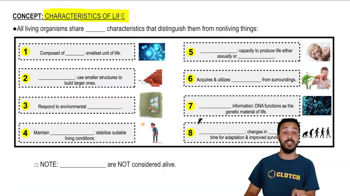
 09:26
09:26