 Indietro
General Biology Exam 1 Study Guide
 02:09
02:09

Termini in questo insieme (31)
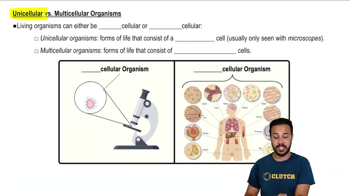
Biology is the study of life and living organisms.
Order, regulation, growth and development, energy processing, response to environment, reproduction, and evolutionary adaptation.
Viruses lack cellular structure and cannot reproduce or carry out metabolism independently.
The atom is the lowest level of biological organization.
Atom < molecule < cell < tissue < organ < organ system < organism < population < community < ecosystem < biosphere.
A hypothesis is a testable prediction; a theory is a well-supported, broad explanation of natural phenomena.
Observation, question, hypothesis, experiment, data collection, conclusion, and communication.
Independent variable is manipulated; dependent variable is measured or observed.
Claims or beliefs presented as scientific but lacking empirical support or method.
Matter is anything with mass and volume; an element is a pure substance of one type of atom; a compound is a substance of two or more elements chemically combined.
Carbon (C), Hydrogen (H), Oxygen (O), and Nitrogen (N).
A trace element is required in minute amounts for proper biological function.
An atom has a nucleus with protons and neutrons, surrounded by electrons in orbitals.
Valence electrons are electrons in the outer shell; they determine chemical bonding.
Polar covalent bonds share electrons unequally; nonpolar covalent share equally; ionic bonds transfer electrons.
Cohesion is water molecules sticking to each other; adhesion is water molecules sticking to other surfaces.
Ice is less dense than liquid water due to hydrogen bonding; it insulates aquatic life in winter.
Acids increase H+ concentration; bases decrease it; pH scale measures acidity from 0 (acidic) to 14 (basic), 7 is neutral.
A buffer stabilizes pH by absorbing or releasing H+ ions.
Carbon has four valence electrons allowing it to form four covalent bonds, creating diverse molecules.
A macromolecule is a large molecule; classes are carbohydrates, lipids, proteins, and nucleic acids.
A chemical reaction that links monomers by removing water.
A reaction that breaks polymers into monomers by adding water.
Monosaccharides are simple sugars; disaccharides are two monosaccharides linked.
A fat molecule formed by glycerol and three fatty acids via dehydration reactions.
Saturated have no double bonds and are solid at room temp; unsaturated have double bonds and are liquid.
A molecule with two fatty acids and a phosphate group; forms cell membranes.
Proteins are polymers of amino acids; they perform structural, enzymatic, and regulatory roles.
The linear sequence of amino acids in a polypeptide chain.
Changes in pH, temperature, or chemicals that disrupt protein shape and function.
DNA stores genetic information for cell function and heredity.