Skip to main content
General Biology
Il mio corso
Impara
Preparazione agli esami
AI Tutor
Guide di studio
Soluzioni per libri di testo
Flashcard
Esplora
Prova l'app
Il mio corso
Impara
Preparazione agli esami
AI Tutor
Guide di studio
Soluzioni per libri di testo
Flashcard
Esplora
Prova l'app
Indietro
General Biology Exam 1 Study Guide
Puoi toccare per girare la carta.
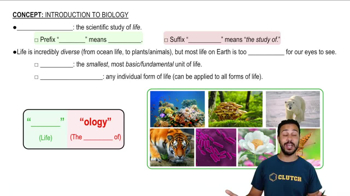
What is the smallest organized unit of life?
Puoi toccare per girare la carta.
👆
What is the smallest organized unit of life?
The
cell
is the smallest organized unit of life, possessing a plasma membrane, cytoplasm, and genetic material.
Avanzamenti del tracciato
I pulsanti di controllo sono stati cambiati in modalità "navigazione".
1/29
Video consigliati
02:09
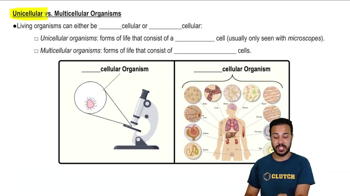
Unicellular vs. Multicellular
37737
views
1384
rank
2
comments
02:54
Introduction to Biology
59819
views
2203
rank
14
comments
1:28
Introduction to Biology Channel
70860
views
1799
rank
15
comments
Termini in questo insieme (29)
Nascondere definizioni
What is the smallest organized unit of life?
The
cell
is the smallest organized unit of life, possessing a plasma membrane, cytoplasm, and genetic material.
What are the two main types of cells?
Prokaryotic
cells lack a nucleus, while
eukaryotic
cells have a nucleus and are generally larger and more complex.
What are the unifying themes of biology?
Organization, Information, Energy and Matter, Interactions, Evolution, and Emergent Properties.
What subatomic particles make up an atom?
Protons (positive charge), neutrons (neutral), and electrons (negative charge).
What determines an element's atomic number?
The number of
protons
in the nucleus determines the atomic number and element identity.
What is the role of valence electrons?
Valence electrons are in the outer shell and determine an atom's chemical reactivity.
What are covalent and ionic bonds?
Covalent bonds
share electrons between atoms;
ionic bonds
transfer electrons, forming charged ions.
What causes polarity in molecules?
Unequal sharing of electrons due to differences in
electronegativity
causes partial charges and polarity.
What are hydrogen bonds and Van der Waals interactions?
Hydrogen bonds form between polar molecules; Van der Waals interactions are weak attractions between molecules.
What are the emergent properties of water?
Cohesion, adhesion, temperature moderation, ice floating due to lattice formation, and solvent properties.
How is pH defined and what do acids and bases do?
pH measures hydrogen ion concentration; acids increase H+ concentration, bases decrease it, and buffers minimize pH changes.
What is the significance of carbon in organic molecules?
Carbon's versatility allows it to form diverse organic molecules essential for life.
What are isomers and enantiomers?
Isomers have the same formula but different structures; enantiomers are mirror-image isomers important in drug design.
Name the seven functional groups important in organic chemistry.
Hydroxyl, Carbonyl, Carboxyl, Amino, Sulfhydryl, Phosphate, and Methyl groups.
What are the four main classes of macromolecules?
Carbohydrates, Lipids, Proteins, and Nucleic Acids.
How are polymers formed and broken down?
Polymers form by
dehydration reactions
and break down by
hydrolysis
.
What are monosaccharides and polysaccharides?
Monosaccharides are simple sugars (e.g., glucose); polysaccharides are long chains like starch, glycogen, and cellulose.
What distinguishes saturated from unsaturated fatty acids?
Saturated fatty acids have no double bonds; unsaturated fatty acids have one or more double bonds.
What is the structure and function of phospholipids?
Phospholipids have hydrophilic heads and hydrophobic tails; they form the major component of cell membranes.
What are the four levels of protein structure?
Primary (amino acid sequence), secondary (hydrogen bonds), tertiary (R-group interactions), and quaternary (multiple polypeptides).
What is the central dogma of molecular biology?
DNA is transcribed into RNA, which is translated into protein.
What are the components of nucleotides?
A phosphate group, a sugar, and a nitrogenous base.
What bases pair in DNA and RNA?
DNA: A pairs with T, G pairs with C; RNA: A pairs with U, G pairs with C.
What is the difference between prokaryotic and eukaryotic cells?
Prokaryotes lack a nucleus and membrane-bound organelles; eukaryotes have both.
What is the function of the rough and smooth endoplasmic reticulum?
Rough ER synthesizes proteins; smooth ER synthesizes lipids and detoxifies.
What is the role of mitochondria and chloroplasts?
Mitochondria perform cellular respiration; chloroplasts perform photosynthesis.
What is the endosymbiont theory?
Mitochondria and chloroplasts originated from engulfed prokaryotic cells.
What is the cytoskeleton and its components?
A network of fibers including microtubules, microfilaments, and intermediate filaments that provide structure and movement.
What is the extracellular matrix (ECM) and integrins?
The ECM surrounds animal cells providing support and signaling; integrins connect ECM to the cytoskeleton.
 IndietroIndietro
 02:09