 Indietro
General Biology Exam 1 Study Guide (Chapters 1-5)
 09:26
09:26
Termini in questo insieme (26)
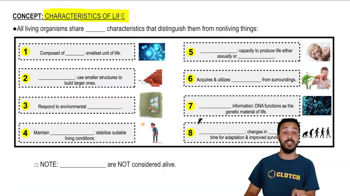
Characteristics that define living organisms: order, regulation, growth and development, energy processing, response to environment, reproduction, and evolution.
Hierarchy from smallest to largest: molecule, cell, tissue, organ, organ system, organism, population, community, ecosystem, biosphere.
Prokaryotic cells lack a nucleus and membrane-bound organelles; eukaryotic cells have a nucleus and organelles.
Eukarya have eukaryotic cells; Archaea and Bacteria are prokaryotes but differ in membrane lipids and genetics.
Scientific method involves observation, hypothesis, experimentation, and conclusion. A hypothesis is a testable prediction; a theory is a well-supported explanation.
Change in heritable traits of populations over generations, driven by natural selection and genetic variation.
Atoms consist of protons (+), neutrons (neutral), and electrons (-). Mass is mostly from protons and neutrons.
The outermost electron shell of an atom; determines chemical reactivity and bonding.
Measure of an atom's ability to attract electrons in a bond; influences bond type and polarity.
Atoms are basic units; isotopes differ in neutron number; ions have charge; elements are pure substances; molecules are bonded atoms.
Water is cohesive, adhesive, has high specific heat, expands when frozen, and is a universal solvent.
Covalent bonds share electrons; ionic bonds transfer electrons; hydrogen bonds are weak attractions between polar molecules; Van der Waals are weak, transient attractions.
Measure of hydrogen ion concentration; pH 7 is neutral, below 7 acidic, above 7 basic.
Decrease in ocean pH due to increased CO2 absorption, harming marine life.
Compounds mainly made of carbon atoms bonded to hydrogen, oxygen, nitrogen, and others.
Structural isomers differ in covalent arrangement; cis-trans isomers differ in spatial arrangement; enantiomers are mirror images.
Specific groups of atoms with characteristic properties, e.g., hydroxyl, carbonyl, carboxyl, amino, phosphate, methyl.
Organic molecules consisting only of carbon and hydrogen, often hydrophobic and energy-rich.
ATP stores energy in phosphate bonds; ADP is ATP after losing a phosphate, releasing energy.
Composed of monosaccharides; function as energy sources and structural materials.
Polymers of amino acids; functions include enzymes, structure, transport, and signaling.
Polymers of nucleotides; store and transmit genetic information (DNA, RNA).
Hydrophobic molecules including fats, phospholipids, and steroids; function in energy storage and membranes.
Lipids are not made of repeating monomers linked by covalent bonds, unlike carbohydrates, proteins, and nucleic acids.
Primary: amino acid sequence; secondary: alpha helices and beta sheets; tertiary: 3D folding; quaternary: multiple polypeptides.
Protein function depends on its 3D shape, determined by its primary to quaternary structure levels.