 Indietro
General Biology Exam 1 Study Guide
 09:26
09:26
Termini in questo insieme (42)
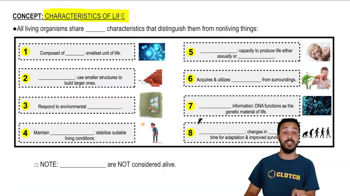
Living things must have cellular organization, metabolism, homeostasis, growth, reproduction, response to stimuli, and adaptation through evolution.
Evolution, structure and function, information flow, energy transformations, and systems biology.
Molecule, cell, tissue, organ, organism, population, community, ecosystem, biosphere. Example: cell - neuron; organ - heart.
Prokaryotes lack a nucleus and membrane-bound organelles; eukaryotes have a nucleus and organelles.
Genes are DNA segments; nucleotides are DNA building blocks; gene expression is making proteins from genes via transcription and translation.
Transcription: DNA to RNA; translation: RNA to protein.
Energy flows from the sun to producers to consumers, and is lost as heat in each transfer.
Archaea (extremophiles), Bacteria (E. coli), Eukarya (plants, animals, fungi, protists).
Protists (algae), Fungi (mushrooms), Plantae (trees), Animalia (mammals).
Variation exists; more offspring are produced than survive; survival depends on traits; favorable traits increase over generations.
Natural selection is a mechanism that drives evolution, the change in allele frequencies over time.
Diagrams showing evolutionary relationships; branches represent common ancestors.
Observation, question, hypothesis, prediction, experiment, analysis, conclusion.
Electrons are involved in chemical bonding and reactions.
Protons = atomic number; Neutrons = mass number - atomic number; Electrons = protons (neutral atom).
First shell: 2 electrons; second shell: 8 electrons; third shell: 8 electrons (for most elements).
Cis: same side; trans: opposite side of a double bond or molecule.
Used in medical imaging, cancer treatment, and dating fossils.
Ionic (salts), covalent (molecules), hydrogen (water), Van der Waals (molecules close together).
Polar molecules have uneven charge distribution; nonpolar molecules have even charge distribution.
Weak attractions between molecules due to transient charge differences.
Polar, forms hydrogen bonds, cohesive, adhesive, high specific heat, expands when frozen.
Cohesion, moderation of temperature, expansion upon freezing, solvent properties.
Specific heat = amount of heat absorbed / (mass × temperature change).
Water absorbs/releases heat slowly due to hydrogen bonding, stabilizing temperatures.
Heat is lost when water evaporates, cooling the surface.
Acids increase H+ concentration; bases increase OH- concentration in solution.
Lower pH reduces carbonate ions needed for shell and skeleton formation.
Study of carbon-containing compounds and their reactions.
Carbon forms four stable covalent bonds, allowing complex, diverse molecules.
Oxygen: 2; Hydrogen: 1; Nitrogen: 3; Carbon: 4 valence electrons.
Hydroxyl, carbonyl, carboxyl, amino, sulfhydryl, phosphate, methyl groups.
Adenosine triphosphate stores and transfers energy in cells.
Simulated early Earth conditions, producing organic molecules from inorganic precursors.
Carbohydrates, proteins, nucleic acids; lipids are not polymers.
Dehydration links monomers by removing water; hydrolysis breaks bonds by adding water.
Monosaccharides, disaccharides, polysaccharides.
Aldoses have an aldehyde group; ketoses have a ketone group.
A carbon attached to four different groups, creating chirality.
Starch in plants, glycogen in animals.
Cellulose in plants, chitin in fungi and animals.
Fats store energy; saturated fatty acids have no double bonds; unsaturated have double bonds; phospholipids form membranes; steroids have four rings.