 Indietro
General Biology Exam 2 Study Guide
 01:17

Termini in questo insieme (27)
Dehydration synthesis is a condensation reaction where monomers are joined by removing a water molecule, forming a covalent bond.
Hydrolysis is the process of breaking polymers into monomers by adding water, breaking covalent bonds.
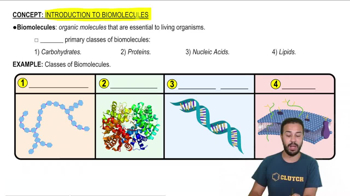
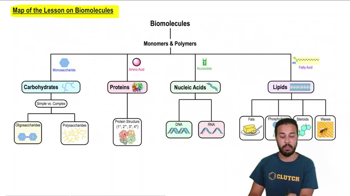
Carbohydrates: monosaccharides, Proteins: amino acids, Nucleic acids: nucleotides.
A glycosidic linkage is the covalent bond formed between two monosaccharides during dehydration synthesis to form disaccharides.
Starch: plant energy storage, glycogen: animal energy storage, cellulose: plant cell wall structure, chitin: exoskeleton structure in arthropods.
Phospholipids have a hydrophilic head and two hydrophobic tails, making them amphipathic, essential for cell membrane bilayer formation.
Saturated fats have single bonds and are solid at room temperature; unsaturated fats have one or more double bonds and are liquid at room temperature.
Primary: amino acid sequence; Secondary: coils/folds; Tertiary: 3D shape from side chain interactions; Quaternary: multiple polypeptides.
Denaturation is the loss of protein structure and function due to external stress like heat; sometimes reversible, sometimes not.
DNA is double-stranded with deoxyribose sugar and thymine; RNA is single-stranded with ribose sugar and uracil instead of thymine.
All living things are made of cells; cells are the basic unit of life; new cells arise from existing cells.
All cells have DNA, ribosomes, cytoplasm, and a plasma membrane.
Prokaryotes lack membrane-bound organelles and nucleus; eukaryotes have membrane-bound organelles and a nucleus.
The nucleus controls cell metabolism, contains chromosomes (DNA), and has a nucleolus that produces ribosomes.
Rough ER has ribosomes and synthesizes proteins; Smooth ER synthesizes lipids and detoxifies chemicals.
The Golgi apparatus modifies, packages, and ships proteins and lipids from the ER to other parts of the cell.
Mitochondria metabolize glucose and produce ATP, the cell's energy currency.
Chloroplasts perform photosynthesis, converting sunlight, CO2, and water into glucose in plant cells.
The plasma membrane is a fluid bilayer of phospholipids with embedded proteins, cholesterol, and carbohydrates forming a mosaic.
Includes diffusion, osmosis, and facilitated diffusion; moves substances down concentration gradients without energy.
Requires ATP to move substances against concentration gradients using carrier proteins like pumps.
Uses ATP to expel 3 Na+ ions and import 2 K+ ions, maintaining cell ion balance and membrane potential.
Pinocytosis (liquid uptake), phagocytosis (large particle uptake), and receptor-mediated endocytosis (targeted uptake).
Water moves from hypotonic to hypertonic solutions; animal cells may lyse or crenate; plant cells become turgid or plasmolyzed.
Channel proteins that facilitate rapid water movement across cell membranes during osmosis.
Plant cells have a cellulose cell wall for support; animal cells have an extracellular matrix for structural support.
Plasmodesmata are channels between plant cells; animal cells have tight junctions, desmosomes, and gap junctions.