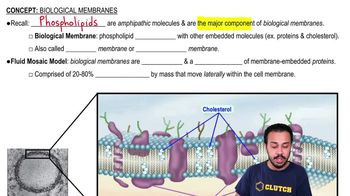
What is the plasma membrane and its major functions?
Separates and controls traffic into and out of cells; found outside of cells in all cell types.
What is the fluid mosaic model?
Membrane is a fluid structure with proteins embedded or attached to a double layer of phospholipids.
How do temperature and cholesterol influence membrane fluidity?
Higher temperature increases fluidity; cholesterol fills holes to stabilize membrane fluidity.
What are peripheral and integral membrane proteins?
Peripheral proteins are loosely bound to membrane surface; integral proteins penetrate the hydrophobic core.
What is meant by a selectively permeable membrane?
Membrane that allows some molecules to cross more easily than others.
Which molecules cross the plasma membrane easily and which do not?
Small, hydrophobic, uncharged molecules cross easily; large, ionic, or polar molecules require transport proteins.
Difference between passive and active transport?
Passive transport requires no energy and moves molecules down their concentration gradient; active transport requires energy to move molecules against the gradient.
What is osmosis?
Diffusion of water across a selectively permeable membrane.
Define hypertonic, hypotonic, and isotonic solutions.
Animal cells: hypo causes lysis, iso normal, hyper shriveled. Plant cells: hypo turgid, iso flaccid, hyper plasmolyzed.
What is facilitated diffusion?
Passive movement of molecules down their concentration gradient via transport proteins.
What are aquaporins?
Gated channel proteins that facilitate water transport across membranes.
What is active transport? Give an example.
Energy-requiring transport moving molecules against their gradient; example: sodium-potassium pump.
Difference between endocytosis and exocytosis?
Endocytosis brings materials into the cell; exocytosis releases substances from the cell.
What is a signal transduction pathway?
Process converting a signal on a cell’s surface into a specific cellular response.
Define paracrine, synaptic, endocrine, and direct contact signaling.
Paracrine: local signaling; Synaptic: nerve cell neurotransmitters; Endocrine: hormones over long distances; Direct contact: cell-to-cell communication.
What are the three stages of cell signaling?
Reception: ligand binds receptor; Transduction: signal relayed and amplified; Response: specific cellular activity triggered.
What is a ligand?
A molecule that binds specifically to a receptor to initiate signaling.
What is metabolism?
Collection of all chemical reactions in an organism.
Difference between catabolic and anabolic pathways?
Catabolic pathways release energy by breaking down molecules; anabolic pathways consume energy to build molecules.
What are the first and second laws of thermodynamics?
First: energy cannot be created or destroyed; Second: energy transformations increase entropy (disorder).
What is free energy (G)?
Energy in a system available to do work.
Difference between exergonic and endergonic reactions?
Exergonic reactions release free energy (ΔG negative); endergonic reactions absorb free energy (ΔG positive).
What is ATP and how is it used by cells?
Adenosine triphosphate; main energy currency; energy released by hydrolysis powers cellular work.
What is an enzyme and how does it function?
A catalytic protein that lowers activation energy to speed up reactions without changing ΔG.
What is activation energy?
Energy required to start a chemical reaction by overcoming the energy barrier.
What are cofactors and why are vitamins and minerals important?
Nonprotein helpers for enzymes; vitamins and minerals often serve as cofactors.
Compare competitive and noncompetitive enzyme inhibitors.
Competitive inhibitors block substrate binding at active site; noncompetitive inhibitors bind elsewhere altering enzyme function.
What is feedback inhibition?
End product of a metabolic pathway inhibits an earlier step to prevent overproduction.
What is cellular respiration?
Process of harvesting chemical energy by breaking down sugars, mainly in mitochondria.
What are oxidation and reduction in redox reactions?
Oxidation: loss of electrons; reduction: gain of electrons.
What is glycolysis and where does it occur?
Breakdown of glucose into pyruvate; occurs in cytoplasm.
What is the role of the electron transport chain?
Transfers electrons to oxygen through proteins in inner mitochondrial membrane, creating a proton gradient for ATP synthesis.
What is chemiosmosis?
ATP synthesis powered by proton gradient across membrane.
What is fermentation and why does it occur?
Anaerobic ATP production when oxygen is absent; partial sugar breakdown.
What is an autotroph and a heterotroph?
Autotrophs produce organic molecules from CO2; heterotrophs consume organic compounds from others.
What is the primary function of chloroplasts?
Site of photosynthesis; contains chlorophyll; found in mesophyll cells.
What is the basic chemical equation for photosynthesis?
6CO2 + 6H2O + light energy → C6H12O6 + 6O2.
Where do light reactions occur and what do they produce?
Occur in thylakoid membranes; produce ATP, NADPH, and oxygen.
What is the Calvin cycle and where does it occur?
Carbon fixation cycle in stroma; uses ATP and NADPH to produce sugar from CO2.
What is photorespiration and why is it harmful?
Oxygen competes with CO2 in Calvin cycle, reducing photosynthetic efficiency.
How do C4 and CAM plants minimize photorespiration?
By spatial (C4) or temporal (CAM) separation of carbon fixation and Calvin cycle.
 Indietro
 02:21