 Indietro
General Biology Exam 3 Study Guide
 02:17

Termini in questo insieme (30)
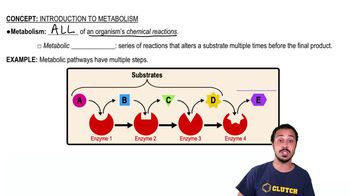
Metabolism is the sum of all chemical reactions that happen in a cell or organism.
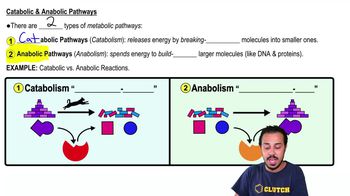
Catabolic pathways break larger molecules into smaller ones and release energy. Anabolic pathways build larger molecules from smaller ones and require energy.
Hydrolysis adds water to break bonds (catabolic). Dehydration synthesis removes water to form bonds (anabolic).
Kinetic energy is energy of motion. Potential energy is stored energy based on position or structure, like chemical bonds.
It exchanges both energy and matter with its surroundings, e.g., taking in food and releasing heat and waste.
First law: energy cannot be created or destroyed, only transferred or transformed. Second law: every energy transfer increases entropy; some energy becomes less available, often as heat.
ΔG = ΔH − TΔS, where ΔG is free energy change, ΔH is enthalpy change, T is temperature in kelvin, and ΔS is entropy change.
Entropy measures disorder or energy dispersal. Reactions increasing entropy often favor spontaneity, but spontaneity depends on ΔG, not entropy alone.
Exergonic reactions release free energy (ΔG < 0). Endergonic reactions require energy input (ΔG > 0).
Chemical work (building molecules), transport work (moving substances across membranes), and mechanical work (movement like muscle contraction).
Cells couple energy-releasing reactions, often ATP hydrolysis, to energy-requiring work.
ATP is a nucleotide composed of adenine, ribose sugar, and three phosphate groups.
ATP hydrolysis removes the terminal phosphate, forming ADP + phosphate and releasing free energy, often changing a target molecule’s shape or reactivity.
Enzymes are biological catalysts that speed reactions by lowering activation energy and are not consumed in the reaction.
Even reactions with negative ΔG need an initial energy push to reach the transition state and start bond breaking/forming.
An enzyme’s active site has a specific shape and chemical environment that fits certain substrates, ensuring specificity.
When a substrate binds, the enzyme’s active site changes shape slightly to fit more closely and facilitate the reaction.
Enzymes orient substrates, strain bonds, create favorable environments, or form temporary bonds with substrates.
Increasing substrate increases reaction rate until active sites saturate; then rate levels off.
Temperature, pH, substrate/enzyme concentration, salt conditions, and cofactors affect enzyme shape and activity; extremes can denature enzymes.
Regulation includes competitive/noncompetitive inhibitors, allosteric activators/inhibitors, feedback inhibition, covalent modification, and enzyme synthesis control.
Oxidation is loss of electrons; reduction is gain of electrons. (OIL RIG: Oxidation Is Loss, Reduction Is Gain)
Electrons move from higher to lower potential energy molecules, releasing energy captured to make ATP.
Glycolysis: glucose oxidized, NAD+ reduced to NADH. Pyruvate oxidation: pyruvate oxidized, NAD+ reduced. Citric acid cycle: acetyl carbons oxidized, NAD+/FAD reduced. ETC: NADH/FADH2 oxidized, oxygen reduced.
NAD+ is an electron carrier that accepts electrons and hydrogen to become NADH, transporting them to the ETC.
ETC passes electrons through membrane proteins, pumping H+ to create a gradient that powers ATP synthase; oxygen is the final electron acceptor.
Glycolysis: cytosol. Pyruvate oxidation and citric acid cycle: mitochondrial matrix. Oxidative phosphorylation: inner mitochondrial membrane.
One six-carbon glucose splits into two three-carbon pyruvate molecules.
Two ATP phosphorylate and destabilize glucose and intermediates, enabling splitting and later energy recovery.
Substrate-level phosphorylation transfers phosphate directly to ADP. Oxidative phosphorylation uses the H+ gradient from ETC to drive ATP synthase.