Skip to main content
General Biology
Il mio corso
Impara
Preparazione agli esami
AI Tutor
Guide di studio
Soluzioni per libri di testo
Flashcard
Esplora
Prova l'app
Il mio corso
Impara
Preparazione agli esami
AI Tutor
Guide di studio
Soluzioni per libri di testo
Flashcard
Esplora
Prova l'app
Indietro
General Biology Exam I Review
Puoi toccare per girare la carta.
Taxonomical categories order
Puoi toccare per girare la carta.
👆
Taxonomical categories order
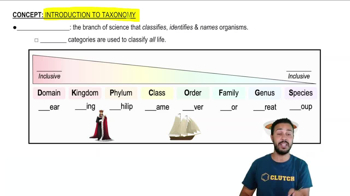
From most broad to most specific: Domain, Kingdom, Phylum, Class, Order, Family, Genus, Species.
Avanzamenti del tracciato
I pulsanti di controllo sono stati cambiati in modalità "navigazione".
1/32
Video consigliati
01:37
Introduction to Taxonomy Example 2
16121
views
335
rank
2
comments
05:48
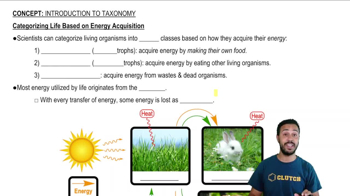
Categorizing Life Based on Energy Acquisition
17530
views
425
rank
3
comments
02:23
Introduction to Taxonomy
29273
views
674
rank
2
comments
Termini in questo insieme (32)
Nascondere definizioni
Taxonomical categories order
From most broad to most specific: Domain, Kingdom, Phylum, Class, Order, Family, Genus, Species.
Definition of a hypothesis
A testable and falsifiable statement that explains a phenomenon; needed to guide scientific experiments.
Types of variables in controlled experiments
Independent variable
is manipulated;
dependent variable
is measured;
controlled variables
are kept constant.
Why controlled experiments are necessary
To isolate the effect of the independent variable by keeping other factors constant.
Conditions for accepting or rejecting a hypothesis
Hypothesis is accepted if experimental results support it; rejected if results contradict it.
States of matter and atomic behavior
Solid:
atoms tightly packed;
liquid:
atoms close but move freely;
gas:
atoms far apart and move rapidly.
Covalent bond definition and example
A bond formed by sharing electron pairs; example: methane (CH4).
Ionic bond definition and example
A bond formed by transfer of electrons creating charged ions; example: sodium chloride (NaCl).
Hydrogen bond definition and example
A weak bond between a hydrogen atom and an electronegative atom; example: water (H2O).
Definition of an isotope
Atoms of the same element with different numbers of neutrons.
Roles of water in living organisms
Solvent, temperature buffer, reactant in chemical reactions, and medium for transport.
Subunits of organic polymers
Carbohydrates:
monosaccharides;
nucleic acids:
nucleotides;
proteins:
amino acids;
lipids:
glycerol and fatty acids.
Protein structure levels
Primary (amino acid sequence), secondary (alpha helices, beta sheets), tertiary (3D folding), quaternary (multiple polypeptides).
Role of ATP in cells
Primary energy currency that stores and transfers energy for cellular processes.
Function of enzymes
Biological catalysts that speed up chemical reactions by lowering activation energy.
Prokaryotic vs. eukaryotic cells
Prokaryotes lack nucleus and membrane-bound organelles; eukaryotes have both.
Significance of cell size and surface-to-volume ratio
Smaller cells have higher surface-to-volume ratio, allowing efficient nutrient and waste exchange.
Functions of the cytoskeleton
Provides cell shape, support, and movement; includes microfilaments, intermediate filaments, and microtubules.
Non-membranous vs. membranous organelles
Non-membranous: ribosomes, cytoskeleton; membranous: nucleus, mitochondria, ER, Golgi apparatus.
Protein synthesis pathway
Proteins are made in ribosomes, processed in rough ER, modified in Golgi, then sent to their destination.
Characteristics of the nucleus
Contains DNA, surrounded by double membrane with pores, controls cell activities.
Structure of the cell membrane
Phospholipid bilayer with hydrophilic heads facing out and hydrophobic tails inward, forming a semi-permeable barrier.
Proteins in the cell membrane
Function as channels, carriers, receptors, enzymes, and anchors for the cytoskeleton.
Fluid Mosaic Model
Describes membrane as a fluid phospholipid bilayer with embedded proteins that move laterally.
Definition of diffusion
Movement of molecules from high to low concentration due to random motion.
Facilitated diffusion
Passive transport using membrane proteins to move molecules that cannot diffuse freely; example: glucose transport.
Active vs. passive transport
Active transport requires energy to move substances against gradient; passive transport does not.
Definition of osmosis
Diffusion of water across a semi-permeable membrane toward higher solute concentration.
Effects of hypertonic, hypotonic, and isotonic solutions on cells
Hypertonic: cell shrinks; hypotonic: cell swells; isotonic: cell remains stable.
Na/K pump function
Active transport that moves 3 Na+ out and 2 K+ into the cell to maintain concentration gradients.
Endocytosis and exocytosis
Endocytosis brings materials into the cell; exocytosis expels materials out.
Three types of cell junctions
Tight junctions:
seal cells;
desmosomes:
anchor cells;
gap junctions:
allow communication.
 IndietroIndietro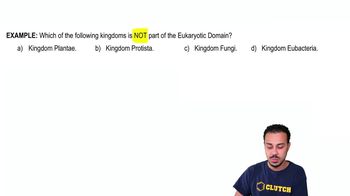
 01:37
01:37