 Indietro
General Biology Exam I Study Guide
 02:13
02:13
Termini in questo insieme (32)
An atom consists of protons (positive charge), neutrons (neutral), and electrons (negative charge). Protons and neutrons form the nucleus, while electrons orbit around it.
The atomic number is the number of protons in an atom's nucleus and defines the element. It relates to electrons in a neutral atom but differs from the mass number.
An isotope is an atom of the same element with the same number of protons but different numbers of neutrons, resulting in different mass numbers.
Highly stable atoms have full valence electron shells, making them chemically inert and unlikely to form bonds.
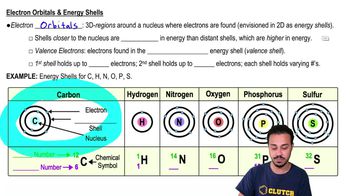
Electrons are arranged in energy levels or shells around the nucleus, with each shell holding a specific maximum number of electrons.
Ionization occurs when atoms gain or lose valence electrons to achieve a full outer shell, forming ions. This depends on an element's position on the periodic table.
Carbon tends to form covalent bonds by sharing electrons because it has four valence electrons and prefers stable sharing rather than losing or gaining electrons.
Acids release H+ ions, bases release OH- ions, and salts form from acid-base neutralization.
pH measures the concentration of H+ ions in a solution, indicating acidity or alkalinity on a scale from 0 to 14.
Main types are ionic bonds (transfer of electrons) and covalent bonds (sharing of electrons).
Ionic bonds form when electrons transfer between atoms (e.g., sodium and chlorine). Covalent bonds form when atoms share electrons (e.g., carbon compounds).
Polarity arises when electrons are shared unequally in a bond, creating partial positive and negative charges.
Electronegativity is an atom's ability to attract electrons; differences cause polar bonds.
Hydrogen bonds form between the positive hydrogen of one water molecule and the negative oxygen of another, giving water cohesion and adhesion.
Carbohydrates provide energy and structural support in organisms.
Monosaccharides are single sugars, disaccharides are two sugars linked, and polysaccharides are long chains of sugars.
Condensation links molecules by removing water; hydrolysis breaks bonds by adding water.
Glucose and fructose are polar due to their hydroxyl groups, making them soluble in water.
Lipids are hydrophobic molecules including fats, oils, and steroids, important for energy storage and membranes.
Lipids are mostly nonpolar hydrocarbons, so they do not form hydrogen bonds with polar molecules.
An amino acid has a central carbon bonded to an amino group, carboxyl group, hydrogen, and a variable R group.
Peptide bonds link amino acids together in proteins through condensation reactions.
Primary: amino acid sequence; secondary: alpha helices and beta sheets; tertiary: 3D folding; quaternary: multiple polypeptides.
Membranes are mainly phospholipid bilayers with embedded proteins for transport and signaling.
Membrane proteins assist in transport, signal reception, and cell recognition.
Passive transport moves substances down concentration gradients without energy; active transport requires energy to move substances against gradients.
Diffusion is movement of solutes; osmosis is diffusion of water across a membrane toward higher solute concentration.
Water crosses membranes rapidly via aquaporin channels that facilitate its movement.
A concentration gradient is the difference in solute concentration across a space or membrane.
All living things are made of cells, cells are the basic unit of life, and all cells come from preexisting cells.
Small size maximizes surface area to volume ratio for efficient nutrient and waste exchange.
Prokaryotes lack a nucleus and membrane-bound organelles; eukaryotes have both.