 Indietro
General Biology Exam II Review
 04:21

Termini in questo insieme (25)
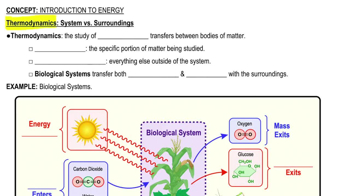
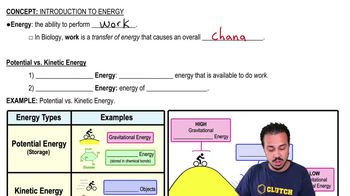
Kinetic energy is energy of motion (e.g., moving molecules). Potential energy is stored energy (e.g., chemical bonds in glucose).
The 1st law states energy cannot be created or destroyed, only transformed. Living organisms convert energy from one form to another but total energy remains constant.
The 2nd law states entropy increases in isolated systems. Organisms maintain order by using energy, increasing entropy in their surroundings.
An enzyme is a protein catalyst that speeds up biochemical reactions by lowering activation energy without being consumed.
Factors include temperature, pH, substrate concentration, and presence of inhibitors or activators.
Competitive inhibitors bind the active site, blocking substrate. Non-competitive inhibitors bind elsewhere, changing enzyme shape and function.
Coenzymes like NADP+ (photosynthesis) and NAD+, FAD (respiration) transfer electrons and energy between molecules.
\(6CO_2 + 6H_2O + light \rightarrow C_6H_{12}O_6 + 6O_2\)
\(C_6H_{12}O_6 + 6O_2 \rightarrow 6CO_2 + 6H_2O + energy (ATP)\)
Light reactions convert light energy into chemical energy (ATP and NADPH) and produce oxygen by splitting water.
Photosystem II (PS II), Electron Transport Chain (ETC), Photosystem I (PS I), ATP synthase, and the H+ gradient.
The Calvin Cycle uses ATP and NADPH to fix CO2 into glucose and other carbohydrates.
Chlorophyll absorbs mainly blue (around 450 nm) and red (around 680 nm) wavelengths.
Phosphorylation is adding a phosphate group to a molecule, e.g., ATP synthesis during cellular respiration.
Redox reactions involve electron transfer; oxidation is loss, reduction is gain. Example: NAD+ reduced to NADH in respiration.
Sources include cellular respiration, decomposition, volcanic activity, and burning fossil fuels.
ETC transfers electrons to create a proton gradient used to produce ATP via ATP synthase.
Mitosis produces two identical diploid cells for growth/repair; meiosis produces four genetically diverse haploid gametes.
G1 (growth), S (DNA replication), G2 (preparation), M (mitosis), and cytokinesis (cell division).
Prophase, Metaphase, Anaphase, Telophase, followed by Cytokinesis.
Humans have 46 chromosomes (23 pairs), diploid cells, chromosomes are linear and packaged in the nucleus.
DNA wraps around histones forming nucleosomes; chromatin condenses into chromosomes.
Heterochromatin is tightly packed, transcriptionally inactive; euchromatin is loosely packed, active for transcription.
They increase genetic variability by shuffling alleles and exchanging DNA between homologous chromosomes.
Mitosis produces 2 identical diploid cells; meiosis produces 4 genetically unique haploid cells with recombination.