Skip to main content
General Biology
Il mio corso
Impara
Preparazione agli esami
AI Tutor
Guide di studio
Soluzioni per libri di testo
Flashcard
Esplora
Prova l'app
Il mio corso
Impara
Preparazione agli esami
AI Tutor
Guide di studio
Soluzioni per libri di testo
Flashcard
Esplora
Prova l'app
Indietro
General Biology: Fossil Dating, Taxonomy, and Phylogenetics
Puoi toccare per girare la carta.
What does relative dating tell us about fossils in stratum A versus stratum C?
Puoi toccare per girare la carta.
👆
What does relative dating tell us about fossils in stratum A versus stratum C?
Fossils in stratum A are older than those in stratum C
because lower strata are deposited earlier in geological time.
Avanzamenti del tracciato
I pulsanti di controllo sono stati cambiati in modalità "navigazione".
1/20
Video consigliati
VideoThumbView.guidedCourse
03:17
Biases in the Fossil Record
2629
views
23
rank
VideoThumbView.guidedCourse
03:54
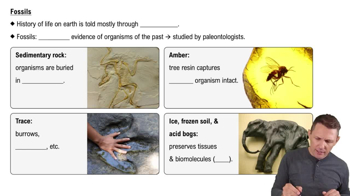
Fossils
2457
views
31
rank
VideoThumbView.guidedCourse
02:59
The Fossil Record Example 1
2225
views
20
rank
Termini in questo insieme (20)
Nascondere definizioni
What does relative dating tell us about fossils in stratum A versus stratum C?
Fossils in stratum A are older than those in stratum C
because lower strata are deposited earlier in geological time.
What can be said about the absolute age of fossils in stratum B?
The absolute age of fossils in stratum B is between the ages of fossils in strata A and C, based on their position.
What is the half-life of Carbon-14 and what isotope does it decay into?
Carbon-14 has a half-life of 5730 years
and decays into the stable isotope
Nitrogen-14
.
If a fossil has 12.5% of its original Carbon-14 remaining, how old is it?
It is approximately
17,190 years old
, because 12.5% corresponds to three half-lives (3 × 5730 years).
How much Carbon-14 remains after 11,500 years if the organism started with 30 grams?
After 11,500 years (about two half-lives),
7.5 grams
of Carbon-14 remains (30 g → 15 g → 7.5 g).
Which Linnean taxonomic rank is the most general and which is the most specific?
Domain
is the most general rank, and
Species
is the most specific rank.
If two species belong to the same family, what other taxonomic ranks must they share?
They must also belong to the same
order, class, phylum, kingdom, and domain
.
In a phylogenetic tree, what does a blue dot on a branch represent?
The blue dot represents a
common ancestor
from which descendant taxa evolved.
Are taxa C and D sister taxa in a phylogenetic tree?
Yes,
C and D are sister taxa
because they share an immediate common ancestor.
Are taxa F and G sister taxa in a phylogenetic tree?
Yes,
F and G are sister taxa
as they share a recent common ancestor.
Are taxon B and the group containing C and D sister taxa?
Yes,
B and the group containing C and D are sister taxa
sharing a common ancestor.
What is the basal taxon in a phylogenetic tree?
The basal taxon is the lineage that diverged earliest from the common ancestor, often at the base of the tree.
What defines a monophyletic group in phylogenetics?
A
monophyletic group
includes an ancestor and
all
of its descendants.
What defines a paraphyletic group?
A
paraphyletic group
includes an ancestor and some, but not all, of its descendants.
What defines a polyphyletic group?
A
polyphyletic group
includes taxa from different ancestors, excluding their most recent common ancestor.
Why might a group be incorrectly classified as polyphyletic?
Because of convergent evolution or incomplete data leading to grouping unrelated taxa based on similar traits.
What is wrong with a group that excludes some descendants of a common ancestor?
It is
paraphyletic
because it does not include all descendants.
What is wrong with a group that combines taxa from different ancestors?
It is
polyphyletic
because it does not include the most recent common ancestor.
How do shared derived characters help construct a phylogenetic tree?
They identify evolutionary relationships by showing traits that evolved in common ancestors and define clades.
What is the significance of sister taxa in evolutionary biology?
Sister taxa share an immediate common ancestor and are each other's closest relatives.
 IndietroIndietro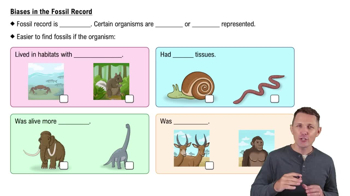
 03:17
03:17