 Indietro
General Biology: Foundations and Cell Biology
 02:09
02:09

Termini in questo insieme (20)
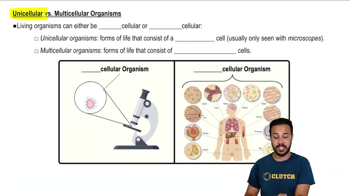
The cell is the fundamental building block of living organisms.
The three domains of life are Archaea, Bacteria, and Eukarya.
Eukarya have cells with organelles, include multicellular organisms, have larger cell size, and distinct ribosomal sequences.
Archaea have small cell size, live in extreme conditions, and have ribosomal sequences and proteasomes similar to eukaryotes.
An atom is the smallest unit of an element or molecule that retains the chemical properties of that element.
A molecule is multiple atoms bound together via covalent bonds.
An element is a pure substance that cannot be broken down into simpler matter by chemical reactions.
Carbon is the basis for most molecules in living organisms, apart from water.
The resolution is limited by the wavelength of visible light.
A typical human erythrocyte is about 7 μm in diameter.
A typical neutrophil has an approximate diameter of 11 μm.
Cell volume increases faster than length because volume scales with the cube of length.
One defining characteristic of a living entity is metabolism or the ability to carry out chemical reactions to sustain life.
Abiogenesis is the natural process by which life arises from non-living matter.
Science involves theoretical activities that lead to testable predictions and explanations that can be falsified by empirical evidence.
Cells serve as the basic building blocks of living organisms.
Most eukaryotic cells measure roughly 10 to 100 μm across their length.
Fluorescence microscopy is used to visualize specific components of cells by tagging them with fluorescent markers.
Ribosomal sequences help distinguish between domains like Bacteria, Archaea, and Eukarya due to their unique patterns.
Life is based on carbon-based molecules and water, which form the chemical foundation of living cells.