Skip to main content
General Biology
Il mio corso
Impara
Preparazione agli esami
AI Tutor
Guide di studio
Soluzioni per libri di testo
Flashcard
Esplora
Prova l'app
Il mio corso
Impara
Preparazione agli esami
AI Tutor
Guide di studio
Soluzioni per libri di testo
Flashcard
Esplora
Prova l'app
Indietro
General Biology: Foundations and Chemical Context of Life
Puoi toccare per girare la carta.
What are the 8 characteristics that define life?
Puoi toccare per girare la carta.
👆
What are the 8 characteristics that define life?
Order, Sensitivity or Response to Stimuli, Reproduction, Adaptation, Growth & Development, Regulation, Homeostasis, Energy Processing
.
Avanzamenti del tracciato
I pulsanti di controllo sono stati cambiati in modalità "navigazione".
1/29
Video consigliati
02:09
Unicellular vs. Multicellular
37380
views
1371
rank
2
comments
02:54
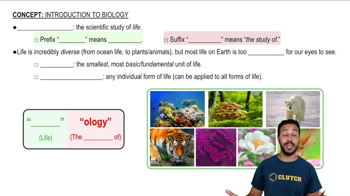
Introduction to Biology
59167
views
2189
rank
14
comments
1:28
Introduction to Biology Channel
69820
views
1772
rank
15
comments
Termini in questo insieme (29)
Nascondere definizioni
What are the 8 characteristics that define life?
Order, Sensitivity or Response to Stimuli, Reproduction, Adaptation, Growth & Development, Regulation, Homeostasis, Energy Processing
.
Why are viruses not considered living organisms?
Viruses
are not composed of cells
and
cannot reproduce on their own
, although they can reproduce inside living organisms.
What is the hierarchical organization of biological life from smallest to largest?
Atoms → Molecules → Organelles → Cells → Tissues → Organs → Organisms → Populations → Communities → Ecosystems → Biosphere.
What is the principle of structural determinism in biology?
The
structure of a biological component dictates its specific functional role
, e.g., bird bones are hollow to optimize flight.
State the three main principles of cell theory.
1. All living organisms are composed of one or more cells. 2. The cell is the basic unit of life. 3. All cells arise from pre-existing cells.
What is the Central Dogma of molecular biology?
Biological information flows from
DNA → mRNA → Protein
through transcription and translation.
How does gene expression produce functional proteins?
DNA is transcribed into mRNA, which is translated into a chain of amino acids that fold into a specific 3D protein shape.
What is systems biology?
An approach that analyzes entire genomes and proteomes simultaneously to understand emergent properties in biological networks.
What is homeostasis and why is it important?
Homeostasis is the maintenance of internal balance, essential for stable biological function despite external changes.
Explain the insulin feedback loop in blood sugar regulation.
High blood sugar triggers insulin secretion, signaling cells to absorb glucose, maintaining metabolic equilibrium.
How does energy flow through an ecosystem?
Energy flows unidirectionally from sunlight to producers via photosynthesis, then to consumers, and is lost as heat.
How does matter cycle in ecosystems?
Matter cycles continuously between living organisms and the environment through processes like nutrient uptake and decomposition.
What are the three domains of life?
Bacteria (prokaryotes), Archaea (prokaryotes, often extremophiles), and Eukarya (eukaryotes including plants, animals, fungi, protists).
What evidence supports the theory of common descent?
Shared molecular and cellular structures, such as the conserved cilia structure in protists and humans.
What is natural selection?
The process where the environment 'selects' for beneficial traits that increase reproductive success.
Define binomial nomenclature.
A two-part scientific naming system for species using genus and species names.
What is the scientific method?
A systematic process involving observation, hypothesis formation, experimentation, data collection, and conclusion.
What is the difference between independent and dependent variables in an experiment?
The independent variable is manipulated (cause), and the dependent variable is measured (effect).
Why can hypotheses never be proven true, only falsified?
Because hypotheses are tentative explanations that can be disproven by evidence but never absolutely confirmed.
What is the difference between a scientific theory and a hypothesis?
A hypothesis is a testable explanation; a theory is a broad, well-supported framework integrating many observations.
What are the six essential elements of life (CHNOPS)?
Carbon, Hydrogen, Nitrogen, Oxygen, Phosphorus, and Sulfur.
What determines an atom's chemical identity?
The number of protons (atomic number) defines the element's identity.
What are isotopes?
Atoms of the same element with different numbers of neutrons, affecting atomic mass.
How do electrons influence chemical bonding?
Valence electrons determine bonding capacity by being shared or transferred to complete outer shells.
What is electronegativity?
An atom's tendency to attract shared electrons in a covalent bond.
What is the difference between covalent and ionic bonds?
Covalent bonds share electron pairs; ionic bonds transfer electrons creating charged ions.
Why are hydrogen bonds important in biology?
They provide weak, transient attractions that stabilize protein folding and DNA structure.
What is chemical equilibrium?
A dynamic steady state where forward and reverse reaction rates are equal, with no net change in concentrations.
Why is metabolic equilibrium incompatible with life?
Because life depends on continuous energy exchange and non-equilibrium states to sustain processes.
 IndietroIndietro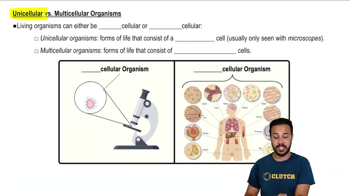
 02:09
02:09