 Indietro
General Biology: Foundations and Chemical Principles of Life
 09:26

Termini in questo insieme (28)
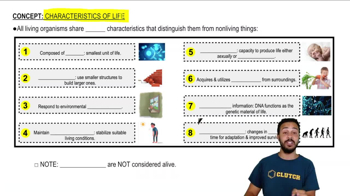
The six unifying themes are order, evolutionary adaptation, response to environment, regulation, energy processing, and growth and development.
The seven processes are order, evolutionary adaptation, response to environment, regulation, energy processing, growth and development, and reproduction.
Reductionist breaks complex systems into parts; systems biology studies interactions and emergent properties of the whole system.
All living organisms are made of cells; cells are the basic unit of life; all cells come from pre-existing cells; genetic material directs cell functions.
Information flows from DNA to RNA to protein, describing gene expression.
Energy flows through ecosystems in one direction, entering as sunlight and exiting as heat, while matter cycles within the system.
Processes where output of a system influences its own activity; includes negative feedback (stabilizing) and positive feedback (amplifying).
Variation exists in populations; more offspring are produced than survive; survival and reproduction depend on traits; advantageous traits accumulate over generations.
1. Observation, 2. Question, 3. Hypothesis, 4. Experiment, 5. Data analysis, 6. Conclusion.
Inductive: generalizing from specific observations; deductive: predicting specific results from general principles.
Includes control group, experimental group, independent variable (manipulated), and dependent variable (measured).
Must be testable, falsifiable, and replicable.
Model organisms help study biological processes due to their simplicity, genetic tractability, and relevance to other species.
Matter is anything with mass and volume; elements are pure substances; compounds are combinations of elements; atoms are smallest units of elements; subatomic particles include protons, neutrons, and electrons.
Atomic number = number of protons; atomic mass = protons + neutrons; isotopes are atoms of the same element with different neutron numbers.
Electrons farther from the nucleus have higher potential energy; energy changes when electrons move between shells.
Electrons occupy shells around the nucleus; the outermost shell is the valence shell, important for chemical bonding.
Covalent, ionic, hydrogen bonds, and van der Waals interactions differ in strength and role in molecules.
Single bonds share one pair of electrons; double bonds share two pairs, affecting molecule shape and reactivity.
Electronegativity differences cause polar or nonpolar covalent bonds, influencing molecule behavior and interactions.
Cohesion, adhesion, high specific heat, and solvent abilities are key water properties supporting life.
Hydrogen bonds cause water's cohesion, surface tension, and adhesion, enabling many biological functions.
Acids increase H+ concentration; bases increase OH- concentration; both affect pH and biological systems.
pH measures hydrogen ion concentration; scale ranges from 0 (acidic) to 14 (basic), with 7 neutral.
Buffers maintain stable pH by reversibly accepting or donating H+ ions.
Carbon skeleton is the chain or ring of carbon atoms forming the backbone of organic molecules.
Structural isomers differ in covalent arrangement; cis-trans isomers differ in spatial arrangement; enantiomers are mirror images.
Carboxyl, Amino, Sulfhydryl, Hydroxyl, Carbonyl, Methyl, and Phosphate groups affect molecule properties.