 Indietro
General Biology: Fundamental Concepts and Processes
 09:26
09:26
Termini in questo insieme (20)
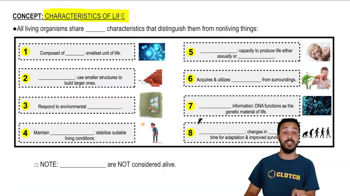
Biology is the study of life, focusing on fundamental mechanisms that underlie all living organisms on Earth.
Emergent properties arise from the arrangement and interactions of parts as complexity increases, such as unique properties of water (H2O) compared to hydrogen and oxygen alone.
Life is organized hierarchically from molecules to cells, tissues, organs, organisms, populations, communities, ecosystems, and the biosphere, with each level contributing to the properties of the next.
All living things are composed of cells, and all cells come from pre-existing cells. The cell is the lowest level at which all life’s properties occur.
Eukaryotic cells have a membrane-bound nucleus and organelles, while prokaryotic cells lack a nucleus and membrane-bound organelles.
The three domains are Bacteria, Archaea, and Eukarya, which include all living organisms.
DNA contains genetic information that is transcribed into RNA, which is then translated into proteins that perform cellular functions.
DNA is copied and passed to daughter cells during reproduction, ensuring offspring inherit traits from both parents.
Energy is needed to perform molecular work such as muscle contraction and DNA replication; organisms acquire and convert energy from their environment.
Energy from sunlight is converted by plants into chemical energy, which flows through organisms via consumption, with heat lost and chemicals recycled by decomposers.
Populations with varied inherited traits undergo differential survival and reproduction, increasing the frequency of traits that enhance survival.
DNA similarity among species helps trace evolutionary relationships and common ancestry.
A hypothesis is a testable explanation that makes predictions and can be supported or refuted by data.
It involves making observations, asking questions, forming hypotheses, making predictions, testing, collecting data, and evaluating results.
Developing a general idea based on specific observations.
Making specific predictions based on a general principle or hypothesis.
Science advances by eliminating incorrect hypotheses and learning from data that contradicts predictions.
Yeast metabolism, measured by CO2 production, increases with temperature up to a maximum, beyond which metabolism declines.
There is a maximum temperature for yeast growth, and glucose may become unstable at high temperatures, limiting yeast use.
Organization, information (genetics), energy and matter, interactions, and evolution/adaptation.