 Indietro
General Biology I: Chapters 1-3 Key Concepts
 09:50

Termini in questo insieme (28)
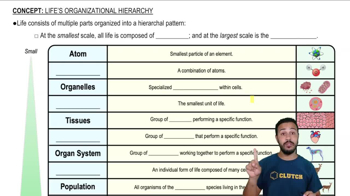
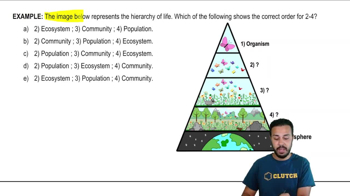
Ecosystem → community → population → organism → organ system → organ → tissue → cell → organelle → molecule → atom.
An ecosystem includes a biological community and its nonliving environment.
A community contains populations of different species; a population contains individuals of one species in an area.
The cell is the fundamental unit of life.
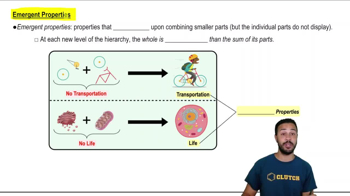
Properties that result from the arrangement and interaction of components at each level of biological organization.
Energy flows through ecosystems and is eventually lost as heat; matter cycles between organisms and the environment.
Prokaryotes lack a nucleus and membrane-enclosed organelles; eukaryotes have both.
Prokaryotes: Bacteria and Archaea; Eukaryotes: Eukarya.
Descent with modification and natural selection based on heritable variation and differential reproductive success.
Discovery science describes patterns through observation; hypothesis-driven science tests explanations with experiments.
A testable explanation for a natural phenomenon.
Atomic number = number of protons; mass number = protons + neutrons.
Isotopes differ in neutron number; ions differ in electron number (gain = negative ion, loss = positive ion).
Nonpolar covalent (equal sharing), polar covalent (unequal sharing), ionic (attraction between ions), hydrogen bonds, and Van der Waals interactions.
Because of unequal electron sharing and its bent shape, oxygen is partially negative and hydrogen partially positive.
Cohesion is attraction among water molecules; adhesion is attraction to other surfaces.
It moderates temperature changes, helping maintain stable environments.
Molarity (M) = moles of solute ÷ liters of solution.
pH = −log₁₀[H⁺]; acidic pH < 7, neutral = 7, basic > 7; each unit represents a tenfold change in H⁺ concentration.
Buffers resist pH changes by accepting or donating H⁺ ions, e.g., the bicarbonate system.
Hydroxyl, carbonyl, carboxyl, amino, sulfhydryl, phosphate, and methyl groups determine chemical behavior.
Structural isomers differ in covalent arrangement; cis-trans differ around double bonds; enantiomers are mirror images.
Carbohydrates, proteins, nucleic acids, and lipids.
Starch (plant energy storage), glycogen (animal energy storage), cellulose (plant cell wall support), chitin (fungal and arthropod support).
A five-carbon sugar, nitrogenous base, and one or more phosphate groups.
DNA: A–T and G–C; RNA: A–U and G–C.
Contains adenine, ribose, and three phosphates; hydrolysis releases energy to power cellular work.
Heat is energy transfer due to temperature difference; temperature reflects average molecular kinetic energy.