Process where cells with the same genome express different sets of genes, producing varied proteins, structures, and functions.
Operon
A cluster of functionally related genes controlled together by a promoter and operator, often transcribed into one mRNA.
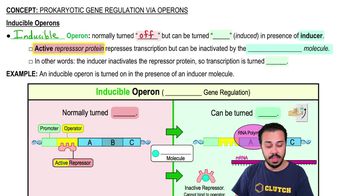
Lac operon regulation
Inducible operon for lactose breakdown; repressor blocks transcription without inducer; allolactose inactivates repressor; expression strongest when lactose is present and glucose is low.
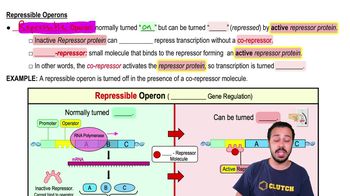
Trp operon regulation
Repressible operon for tryptophan synthesis; transcription allowed when tryptophan is scarce; tryptophan acts as corepressor activating repressor to block transcription when abundant.
Positive regulation of lac operon
Low glucose raises cAMP, allowing CAP–cAMP complex to stimulate transcription; high glucose reduces CAP activation.
DNA packaging and transcription
DNA wraps around histones forming nucleosomes; tightly packed chromatin limits gene access; histone acetylation promotes accessibility; DNA methylation often silences genes.
Eukaryotic transcription regulation
Depends on general transcription factors, RNA polymerase, specific activators/repressors, and control elements like enhancers; DNA looping brings distant elements close.
RNA processing steps
Pre-mRNA is processed by adding a 5′ cap, poly-A tail, and splicing out introns; alternative splicing allows multiple protein forms from one gene.
Post-transcriptional regulation
Includes mRNA stability, localization, translation initiation, small regulatory RNAs (miRNAs, siRNAs), protein modification, and degradation.
Cell signaling stages
Reception (signal binds receptor), transduction (signal relay/amplification), and response (cell changes gene expression or behavior).
Darwin's theory of natural selection
Individuals vary in heritable traits; more offspring are produced than resources allow; those with advantageous traits leave more offspring, changing allele frequencies over generations.
Fitness in evolution
Relative reproductive success of an individual in a particular environment.
Evidence for evolution: fossil record
Shows change through time, extinction, and transitions between ancestral and descendant forms.
Homologous vs. analogous structures
Homologous structures share common ancestry; analogous structures have similar functions but evolved independently.
Binomial nomenclature rules
Species name has two parts: genus (capitalized) and specific epithet (lowercase), both italicized; specific epithet alone is not the full species name.
Phylogenetic tree branch point
Represents the inferred common ancestor of the descendant lineages.
Clade (monophyletic group)
A group consisting of a common ancestor and all its descendants.
Genetic drift
Random changes in allele frequencies, especially in small populations, which can fix or eliminate alleles regardless of fitness.
Founder effect
When a new population is established by a small, unrepresentative sample of the original population, causing genetic drift.
Hardy-Weinberg equilibrium assumptions
No mutation, random mating, no natural selection, infinitely large population, and no gene flow.
Favors one extreme phenotype, shifting the population distribution toward that extreme.
Stabilizing selection
Favors intermediate phenotypes, reducing variation around the average.
Disruptive selection
Favors both extreme phenotypes over intermediate ones, increasing variation within the population.
Gene flow
Movement of alleles between populations through migration and reproduction, often making populations more similar.
Alternative splicing
Process that joins different combinations of exons to produce multiple mRNA and protein variants from one gene.
Role of small regulatory RNAs
miRNAs and siRNAs guide complexes that inhibit translation or promote degradation of target RNAs.
Epigenetic mechanisms
Heritable changes in gene expression not involving DNA sequence changes, such as DNA methylation and histone modification.
Difference between prokaryotic and eukaryotic gene regulation
Prokaryotes often use operons with coupled transcription and translation; eukaryotes regulate chromatin, process RNA, and separate transcription from translation.
 Indietro
 04:25