Skip to main content
General Biology
Il mio corso
Impara
Preparazione agli esami
AI Tutor
Guide di studio
Soluzioni per libri di testo
Flashcard
Esplora
Prova l'app
Il mio corso
Impara
Preparazione agli esami
AI Tutor
Guide di studio
Soluzioni per libri di testo
Flashcard
Esplora
Prova l'app
Indietro
General Biology: Inside the Cell
Puoi toccare per girare la carta.
Why are microscopes necessary in biology?
Puoi toccare per girare la carta.
👆
Why are microscopes necessary in biology?
Microbes and many cellular structures are too small to be seen with the naked eye, so microscopes are used to visualize them.
Avanzamenti del tracciato
I pulsanti di controllo sono stati cambiati in modalità "navigazione".
1/24
Video consigliati
06:35
Microscopes
24913
views
567
rank
02:52
Types of Electron Microscopes
17875
views
357
rank
1
comments
Termini in questo insieme (24)
Nascondere definizioni
Why are microscopes necessary in biology?
Microbes and many cellular structures are too small to be seen with the naked eye, so microscopes are used to visualize them.
What are the two main types of microscopes?
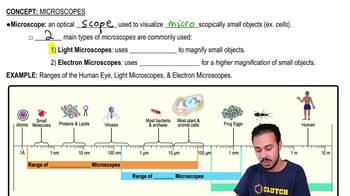
Light microscopes use visible light to magnify objects, while electron microscopes use electron beams for higher magnification.
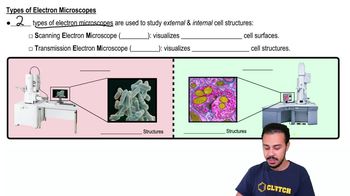
Difference between Scanning Electron Microscope (SEM) and Transmission Electron Microscope (TEM)?
SEM visualizes external cell surfaces; TEM visualizes internal cell structures.
What are the two broadest cell types in life?
Prokaryotic cells, which lack a nucleus, and eukaryotic cells, which have a nucleus and membrane-bound organelles.
Which domains of life are prokaryotic?
Bacteria and Archaea are classified as prokaryotes.
Where is bacterial DNA located?
In the nucleoid region, not enclosed by a membrane.
What is a key difference in ribosomes between prokaryotes and eukaryotes?
Prokaryotes have small 70S ribosomes; eukaryotes have larger 80S ribosomes.
What organelle packages genetic material in eukaryotic cells but not in prokaryotes?
The nucleus packages and protects DNA in eukaryotic cells.
Name three common features shared by all cells.
Contain DNA, have a cell membrane or wall, and contain cytoplasm.
What are ribosomes and their function?
Ribosomes are molecular machines that synthesize proteins in all living cells.
Difference between free and bound ribosomes?
Free ribosomes float in the cytoplasm; bound ribosomes are attached to the rough ER.
What are the two organelles that produce cellular energy in eukaryotes?
Mitochondria and chloroplasts.
What is ATP and its role?
Adenosine Triphosphate (ATP) is a high-energy molecule that powers cellular reactions.
Describe the structure of mitochondria.
Mitochondria have two membranes: an outer membrane and a folded inner membrane called cristae, with a matrix inside containing DNA and enzymes.
What process occurs in chloroplasts?
Photosynthesis, which uses sunlight to synthesize sugars from carbon dioxide and water.
What are thylakoids and grana in chloroplasts?
Thylakoids are membrane-bound sacs; grana are stacks of thylakoids.
What is the endomembrane system?
A group of membrane-bound organelles in eukaryotic cells involved in protein secretion and cellular digestion.
What is the role of the nucleus in protein secretion?
The nucleus stores DNA and transcribes it into RNA, which codes for proteins.
Difference between rough and smooth endoplasmic reticulum (ER)?
Rough ER has ribosomes and folds proteins; smooth ER lacks ribosomes and synthesizes lipids and detoxifies substances.
What is the function of the Golgi apparatus?
It processes, packages, and ships proteins and lipids received from the ER.
What are lysosomes and peroxisomes?
Lysosomes contain digestive enzymes to break down debris; peroxisomes break down toxic compounds and fatty acids.
What is the central vacuole in plant cells?
A large vesicle that recycles molecules and maintains turgor pressure by storing water.
What is the cytoskeleton and its main components?
A network of proteins providing cell shape, structure, and transport; main components are microfilaments, intermediate filaments, and microtubules.
What structures use microtubules for movement?
Cilia (short, hair-like) and flagella (long, whip-like) provide cell movement.
 IndietroIndietro
 06:35