 Indietro
General Biology: Introduction and Foundations
 02:09
02:09

Termini in questo insieme (29)
Evolution is the process of change that has resulted in the diversity of organisms on Earth and is the fundamental principle of biology.
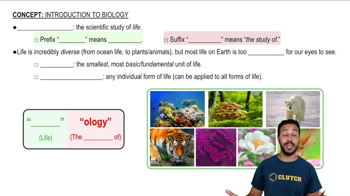
Biology is the scientific study of life, including questions about development, behavior, and interactions of organisms.
Organization, Information, Energy and matter, Interactions, and Evolution are the unifying themes that organize biological information.
Emergent properties arise from the arrangement and interaction of parts within a system, producing new functions not present at lower levels.
Reductionism is the approach of studying complex systems by breaking them down into simpler components.
Systems biology explores biological systems by analyzing interactions among their parts to understand complex functions.
At each biological level, structure correlates with function, so analyzing structure gives clues about function.
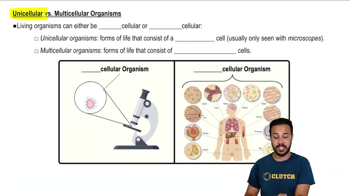
The cell is the smallest unit of life that can perform all activities required for life.
Eukaryotic cells have membrane-bound organelles including a nucleus; prokaryotic cells lack a nucleus and are generally smaller.
DNA (deoxyribonucleic acid) contains genetic material organized into chromosomes and directs development and inheritance.
Genes are units of inheritance made of DNA that transmit information from parents to offspring.
DNA is composed of two long strands forming a double helix, with nucleotides A, T, C, and G as building blocks.
Gene expression is the process of converting information from a gene into a functional protein, using RNA as an intermediary.
Genomics is the study of an organism's entire set of genes and their interactions within and between species.
Proteomics studies the full set of proteins expressed by a cell, tissue, or organism, called the proteome.
Energy enters ecosystems as sunlight, is converted by producers into chemical energy, passed to consumers, and exits as heat.
Chemical elements are recycled within ecosystems, moving through organisms and the environment.
Organisms interact in ways that can benefit both, harm both, or benefit one and harm the other, affecting their environment.
Climate change is a long-term directional change in global climate, affecting species populations and habitats worldwide.
Evolution explains both the unity and diversity of life as living organisms are modified descendants of common ancestors.
The three domains are Bacteria, Archaea (both prokaryotes), and Eukarya (eukaryotic organisms).
Domain Eukarya includes plants, fungi, animals, and protists (mostly unicellular eukaryotes).
Natural selection is the process where individuals with advantageous traits are more likely to survive and reproduce, driving evolution.
Individuals vary in heritable traits, more offspring are produced than survive, and species suit their environments.
Descent with modification means species evolve from common ancestors, accumulating changes over generations.
Scientists form testable hypotheses based on observations and test them through controlled experiments or further observations.
The independent variable is manipulated; the dependent variable is the observed effect or response.
A theory is a broad, well-supported explanation that can generate many testable hypotheses.
Science advances through collaboration, diverse viewpoints, and verification by multiple researchers.